What Designer, Niche, Arabian and Ethical Perfume Brands Mean
Perfume houses fall into three groups by market: designer, niche and independent, and Arabian. None of them is a quality grade, so choose by the scent you like. Where a house is from and whether it is ethical are labels on top.
Which group should I shop first?
Start from the scent you like, then use the group to narrow the shelf.
- Designer: choose it when you want something easy to find and try. Designer perfume sits on department-store counters and in duty-free shops.
- Niche and independent: choose it when you want a smaller house with a narrower audience. These houses sell more selectively, so a sample or a decant is the usual way to try one.
- Arabian: choose it when you want oud, amber or incense-led scents from the Arabian perfume tradition.
- Ethical: choose it when a vegan or cruelty-free claim matters to you. We show whether a register backs the claim.
Whichever group you pick, judge a single perfume on its own verdict, not on its house. A group says how a house is run and sold, not how good its perfume is.
Which groups of houses are there?
Each group has its own page with every house in it and a sample of verdicts. Each house with a tier is in exactly one of the first three, and it may also be ethical.
- Designer A fashion or luxury name on a perfume. 362 houses, 11,595 perfumes
- Niche & Independent Houses built around perfume, and small founder-run studios. 1,385 houses, 24,870 perfumes
- Arabian Houses working in the Arabian perfume tradition. 148 houses, 6,965 perfumes
- Ethical Houses with a vegan or cruelty-free claim across the whole range, and a source for it. 36 certified houses

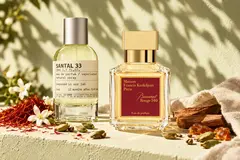


For every house at once, A to Z, use the brands directory, which holds 2,405 houses. A "house" is a company that makes and sells perfume under its own name, and in this guide house and brand mean the same thing.
What is a designer house?
A designer fragrance carries the name of a fashion or luxury house. The idea is a century old. Chanel No. 5, which launched in 1921, was the first perfume from the couturier Coco Chanel (Wikipedia).
Today the perfume is often made under licence. The fashion house lends its name and logo, and a fragrance company makes and sells the bottle, usually in exchange for a fee and royalties on sales (The Fashion Law). Designer perfume has also typically reached a broad audience through duty-free shops and department-store counters (Glossy).
We class a house as Designer when it is a heritage, luxury or fashion-house name.
Examples are Dior, Tom Ford and Gucci.
What to do with this: start with designer perfume when you want a familiar name that is easy to find and try in a shop.
What are niche and independent houses?
Niche perfume is an alternative to mass production. In the words of Wikipedia, it "typically involves a more selective distribution and targets a narrower audience, rather than aiming for mass-market sales" (Wikipedia). Niche houses are generally smaller than the big fragrance firms.
Independent is a narrower word, and people do not agree on it. Wikipedia describes "indie perfume" lines as ones "generally owned and operated by the perfumer themselves". The Institute for Art and Olfaction, which runs the Art and Olfaction Awards, uses a different test: its independent category is for brands that employ an external perfumer or fragrance house to write the formula. It says plainly that "the definition of independent varies widely depending on who you ask" (Art and Olfaction Awards).
The edges are also blurred. Wikipedia notes that since the 2010s "more and more niche perfume brands have been purchased by a larger parent corporation", and that many niche perfumes have become as widely available as designer ones. Niche describes how a house is run and sold. It does not say how good its perfume is.
Because niche and independent overlap so much, ScentVerdict keeps them in one group. We class a house as Niche when it is built around perfume and sells in a selective, specialist way, and as Independent when it is a small-batch studio run by its founder.
Examples are Creed, Amouage and Nishane.
What to do with this: try niche and independent houses through samples or decants, because they sell more selectively and are harder to try in a shop.
What makes a house Arabian?
Arabian perfumery has a long written history. In the ninth century the Arab chemist Al-Kindi wrote the Book of the Chemistry of Perfume and Distillations, which held more than a hundred recipes for fragrant oils, salves and aromatic waters (Wikipedia). AramcoWorld reports that oud, today, "is most prominently used as a perfume ingredient in the Arabian Gulf", and that using it as bakhoor, a burned incense, is deeply ingrained in social customs (AramcoWorld). In most Arab countries the incense is burned as scented chips or blocks (Wikipedia).
On ScentVerdict, Arabian is a tier we assign, not a passport check. Most of the Arabian houses we cover are based in the Gulf, but origin does not decide it on its own. Some Gulf houses are classed Niche, and a few Arabian houses are based elsewhere. We class a house as Arabian when we judge it to belong to Arabian perfumery.
Amouage is a Gulf house that we class as Niche.
Examples are Lattafa, Rasasi and Afnan.
What to do with this: start with an Arabian house when you want oud, amber or incense-led scents, and read the verdict on each perfume to see how it wears.
Does a house's country matter?
Where a house is from is a different question from its tier, so it is not a group. A house is listed under the country it is based in, whatever its tier, and a Designer, a Niche and an Arabian house can all share a country.
Every country with a house has a page. The countries with at least 15 houses are United States, United Kingdom, France, Italy, United Arab Emirates, Germany, Spain, Australia, Saudi Arabia, Netherlands, India, Brazil, Switzerland, Sweden, South Korea, Turkey, Canada, Thailand. See brands by country for every country.
It makes no claim about quality.
What to do with this: use a country page when you want to shop a region's houses together, and ignore it when you only care about the scent.
What does ethical mean for a house?
Ethical is a values label. A house is on the ethical hub when it makes a vegan or cruelty-free claim across its whole range. We mark whether a register backs the claim (Certified) or the brand only says so (Brand-declared), and we never blend the two. Words such as natural, clean and non-toxic have no legal meaning, so they get a guide and no list. Start with the vegan and cruelty-free guides.
What to do with this: use the ethical hub when a vegan or cruelty-free claim matters, and check whether a register backs the claim or the brand only says so.
Can a house be in more than one group?
A house has exactly one tier: Designer, Niche and Independent, or Arabian. It can also carry the Ethical label, and it is always from one country.
For example:
- Molton Brown is a Designer house from United Kingdom, with a certified cruelty-free claim across its range.
- Ellis Brooklyn is a Niche and Independent house from United States, with a certified vegan and cruelty-free claim across its range.
The directory also holds a few other kinds of house, such as celebrity lines and retailer own-brand ranges. They have no tier page of their own.
A house's tier is an editorial call, and every perfume gets the same verdict whatever its house. The method is on How we make our verdicts.
Common questions
What is niche perfume?
Niche perfume comes from houses that sell more selectively, to a narrower audience, than mass-market brands. There is no official test a house must pass, which is why sources draw the line in different places.
Is niche perfume better than designer perfume?
Not by definition. Niche and designer describe how a house is run and sold. The two overlap: many niche perfumes are now as widely available as designer ones. We give every perfume the same verdict, whichever group its house is in.
What is a perfume house?
A company that makes and sells perfume under its own name, from the French word maison. It is not the same as a fragrance company such as Givaudan or Firmenich. Most perfumers work for companies like those, which write formulas for houses and other customers (Wikipedia).
What makes a perfume brand Arabian?
No body decides it. The word points to the Arabian perfume tradition, in which oud and bakhoor are central. On ScentVerdict a house is Arabian when we judge it to belong to that tradition. Where it is based is part of the picture, not the whole of it.
Sources
Checked on 16th October 2026. Where a source gives no firm definition, we say so above rather than write one.
- Niche perfume, Wikipedia
- Chanel No. 5, Wikipedia
- Perfume, Wikipedia
- Perfumer, Wikipedia
- Incense, Wikipedia
- Independent category, The Art and Olfaction Awards, Institute for Art and Olfaction
- Uncovering the Roots of Agarwood Oud Scent Traditions, Nilosree Biswas, AramcoWorld, March 2025
- The Behind-the-Scenes Battles for the Lucrative Gig of Making Luxury Brands' Accessible Goods, The Fashion Law, April 2019
- How designer fragrances are taking cues from niche brands, Glossy, March 2025