EDT vs EDP vs Parfum
EDT, EDP and Parfum tell you how much fragrance oil is in the bottle. More oil usually means a stronger scent, longer wear and a higher price. Choose EDT for heat and casual days, EDP for the office, and Parfum for cold weather and evenings.
In this guide
What are the concentration levels?
Those labels on perfume bottles - Eau de Cologne, Eau de Toilette, Eau de Parfum, Parfum - are not marketing. They tell you the percentage of fragrance oil dissolved in the alcohol carrier. Higher concentration means stronger scent, longer wear, and generally a higher price.
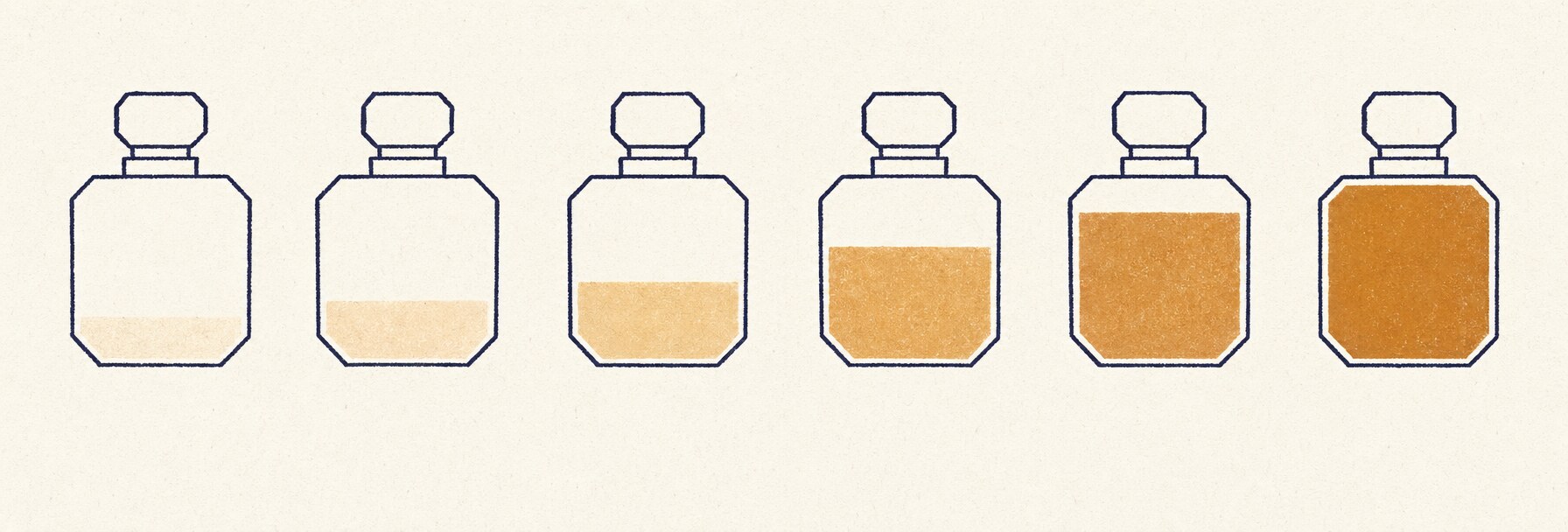
- Eau Fraiche - 1-3% fragrance oil
- Eau de Cologne - 2-5%
- Eau de Toilette - 5-15%
- Eau de Parfum - 15-20%
- Parfum - 20-30%
- Extrait de Parfum - 20-40%
These ranges are industry standards rather than regulations, and they overlap because the industry has never agreed on exact boundaries. Brands do not always print the percentage on the box, so the label tells you roughly where a bottle sits and nothing more precise.
What does concentration mean?
A 100ml bottle of EDT at 10% concentration contains roughly 10ml of fragrance oil and 90ml of alcohol. The same size Parfum at 25% holds about 25ml of oil. The difference is noticeable: the higher-concentration version is richer and lasts longer.
The alcohol is not filler. It helps the fragrance disperse evenly and creates that initial burst of scent when you spray. Higher-concentration fragrances often feel "denser" because there is less alcohol doing the dispersal work.
If you switch from an EDT to the EDP of the same fragrance, you will likely need fewer sprays. Two sprays of an EDP can match four sprays of the EDT. Overspraying an EDP because you are used to EDT quantities is one of the most common fragrance mistakes.
Concentration also changes the balance, not only the strength. An EDT is often bright and transparent, the EDP richer, and the Parfum the densest, darker and more enveloping. Same DNA, different fragrances. Many perfumers reformulate at each concentration rather than only changing the oil-to-alcohol ratio.
How does concentration affect longevity, sillage and price?
Longevity: Higher concentration generally means more hours on skin, but the ingredients matter as much. Musks, ambers, and heavy woods cling for ages even at low doses. Citrus notes evaporate quickly no matter the concentration. A musky EDT can easily outlast a citrus-heavy EDP.
Sillage: More oil generally means a bigger scent trail, but again, the formula matters. Some EDTs project well because they are designed to radiate. Some niche EDPs are designed as intimate skin scents. Concentration sets the baseline; the perfumer's choices determine the actual result.
Price: Higher concentrations cost more, but the markup is not purely proportional. Brands price Parfum versions as the premium expression - nicer packaging, heavier bottles, luxury positioning. The cost per wear can favour higher concentrations. If three sprays of Parfum last all day versus six sprays of EDT, the Parfum bottle lasts twice as long.
If you are trying two concentrations of the same fragrance in a shop, spray the EDT on one wrist and the EDP on the other. Check them at 30 minutes, 2 hours, and 4 hours. The difference in longevity and development becomes obvious - and it helps you decide whether the higher concentration is worth the extra cost for you personally.
Which concentration suits which occasion?
There is no universal "best" concentration - it depends on context:
- Quick refresh / post-gym - Eau de Cologne. Light, citrus-forward, and gone within a couple of hours. Perfect when you want a burst of freshness without committing to a full fragrance. 4711 is the classic example.
- Hot weather / casual daytime - EDT. Heat amplifies fragrance, so lighter concentrations breathe rather than suffocate. Many fresh EDTs are built for this.
- Office / close quarters - EDP (applied sparingly). Two sprays of an EDP will carry you through a full work day without reapplication. Keep the radius small in shared spaces.
- Evening / cooler weather - Parfum or Extrait. Cold air suppresses projection, so winter is when higher concentrations shine. The density means you will not fade by dessert.
- Exercise - Eau Fraiche or body spray. Sweat amplifies scent. Go light - nobody at the gym needs to deal with your Parfum.
Is concentration the whole story?
Concentration labels tell you the quantity of fragrance oil but nothing about its quality or character. Two EDPs at 18% can perform completely differently - a perfumer using long-lasting base materials like ambroxan will get more hours from a lower concentration than one using volatile citrus notes at a higher one.
Your skin matters too. Oily skin holds fragrance longer because the oils slow evaporation. Moisturising before you spray (with an unscented lotion) can improve performance at any concentration.
And not every brand follows the traditional brackets. Some slap "Intense" or "Parfum" on what is an EDP-strength reformulation. Read reviews if you want to know how a specific fragrance performs; the label alone will not tell you.
A well-formulated EDT can outperform a poorly formulated Parfum. Use concentration as one factor among several, alongside ingredients, the brand's track record, and your own skin test.
For more on how scent travels, see our guide to sillage. For matching concentrations to seasons, try our seasonal concentration guide. And for squeezing more hours out of whatever you own, our guide on making perfume last longer covers that.
Common questions
What is the difference between EDT and EDP?
EDT holds about 5-15% fragrance oil and EDP about 15-20%. An EDP is usually stronger and lasts longer, so you often need fewer sprays. Two sprays of an EDP can match four of the EDT.
Which lasts longer, EDT or EDP?
EDP usually lasts longer because it holds more oil. The ingredients matter as much, though. A musky EDT can outlast a citrus-heavy EDP.
Is Parfum always better than EDP?
No. Parfum is more concentrated, but concentration only measures the amount of oil. A well-made EDT can outperform a poorly made Parfum, so judge on your own skin test.
Which concentration should I wear in summer?
EDT or Eau Fraiche. Heat amplifies fragrance, so lighter concentrations breathe rather than overpower.