Pour homme means "for men" in French, and pour femme means "for women": pour is "for", homme is "man" and femme is "woman". Say them "poor om" and "poor fam", because the H in homme is silent. Both are marketing labels that say who the house pictured on the poster, not who may wear the scent, and in our catalogue 479 perfumes carry "pour homme" in the name and 229 carry "pour femme". This guide decodes those two phrases and the other French words you meet on a bottle, with the number of perfumes in our catalogue that use each one.
The French terms on a bottle, decoded
The last column counts published perfumes in our catalogue whose name contains the word (or its plural, for fleur and bois), read on 24th November 2026.
| French term | Literal meaning | What it signals on a bottle | In our catalogue |
|---|---|---|---|
| Pour homme | For a man | Marketed at men. A convention, not a rule - see below. | 479 |
| Pour femme | For a woman | Marketed at women. Same caveat applies. | 229 |
| Pour elle | For her | Same meaning as pour femme, and much less common. | 42 |
| Pour lui | For him | Same meaning as pour homme, and much less common. | 20 |
| Eau | Water | The base word in every "Eau de ..." name. On its own it usually points to a lighter composition. | 1,032 |
| Eau fraiche | Fresh water | A light style, built for warm weather and a close, quiet trail. | 89 |
| Extrait (de parfum) | Extract | A concentrated strength, above Eau de Parfum on the usual ladder. Full detail, with real examples, in our Eau de Parfum vs Eau de Toilette guide. | 94 |
| Absolu | Absolute | A richer, more concentrated-feeling reworking of an existing scent. A marketing word, not a regulated strength. | 199 |
| Intense | Intense | A bigger version of the original, sold alongside it as the "more" option. | 1,076 |
| Elixir | Elixir | A flanker of an existing fragrance, usually pitched as the richer one, and not a fixed strength either. Covered in full in What Is an Elixir Perfume? | 598 |
| Noir | Black | Darker, moodier, more "night" in the marketing sense. Nothing to do with the liquid's actual colour. | 633 |
| Blanc | White | The opposite signal to noir: clean, pale, often musky or powdery in the brief. | 167 |
| L'eau | The water | "L'" is just "the", shortened before a vowel. L'Eau d'Issey means "The Water of Issey". | 274 |
| Edition | Edition | A limited or special run. The same word in both languages. | 751 |
| Sport | Sport | Aimed at active, casual wear. | 186 |
| Bois / boisé | Wood / woody | Signals a woody accord right there in the name. | 234 |
| Fleur | Flower | Signals a floral focus. | 399 |
| Nuit | Night | Signals a more evening-coded composition. | 291 |
What our own data shows
We hold 82,155 published perfumes. The figures below come from their names, their recorded notes and their gender classification, read on 24th November 2026. The method is on our methodology page.
The two labels do track how a perfume is classed. Of the 479 "pour homme" perfumes, 472 are classed masculine, 7 unisex and none feminine. Of the 229 "pour femme" perfumes, 226 are feminine and 3 unisex. Several other words say nothing about gender. Noir is split across 116 masculine, 164 feminine and 352 unisex perfumes, and Elixir across 188, 175 and 235. Sport leans the other way: 151 of its 186 are masculine. Fleur is mostly feminine, 249 of 399.
The label tells you who a bottle is aimed at, and only loosely what it smells like. The 229 "pour femme" perfumes most often list jasmine (61%) and musk (56%), then vanilla (47%), bergamot (41%) and rose (40%). The 479 "pour homme" perfumes most often list bergamot (48%), cedar (46%), patchouli (40%), musk (39%), vetiver (37%) and lavender (36%). Bergamot, musk, patchouli, amber and sandalwood sit in the top eight of both lists.
There is a third pair worth knowing. "L'homme" ("the man") is in 91 names, 80 of them masculine and 11 unisex.
"Pour homme" is a label, not a rule
"Pour homme" and "pour femme" are marketing decisions, not a property of the liquid in the bottle. The words tell you who the house pictured on the poster, not who is allowed to wear it. Notes cross the line all the time: iris, the heart of Dior Homme Intense, is recorded in 1,231 masculine perfumes, 3,481 feminine ones and 4,349 unisex ones. If the notes and the description appeal to you, the words on the box are not a reason to put the bottle back down.
Six bottles that show the words at work
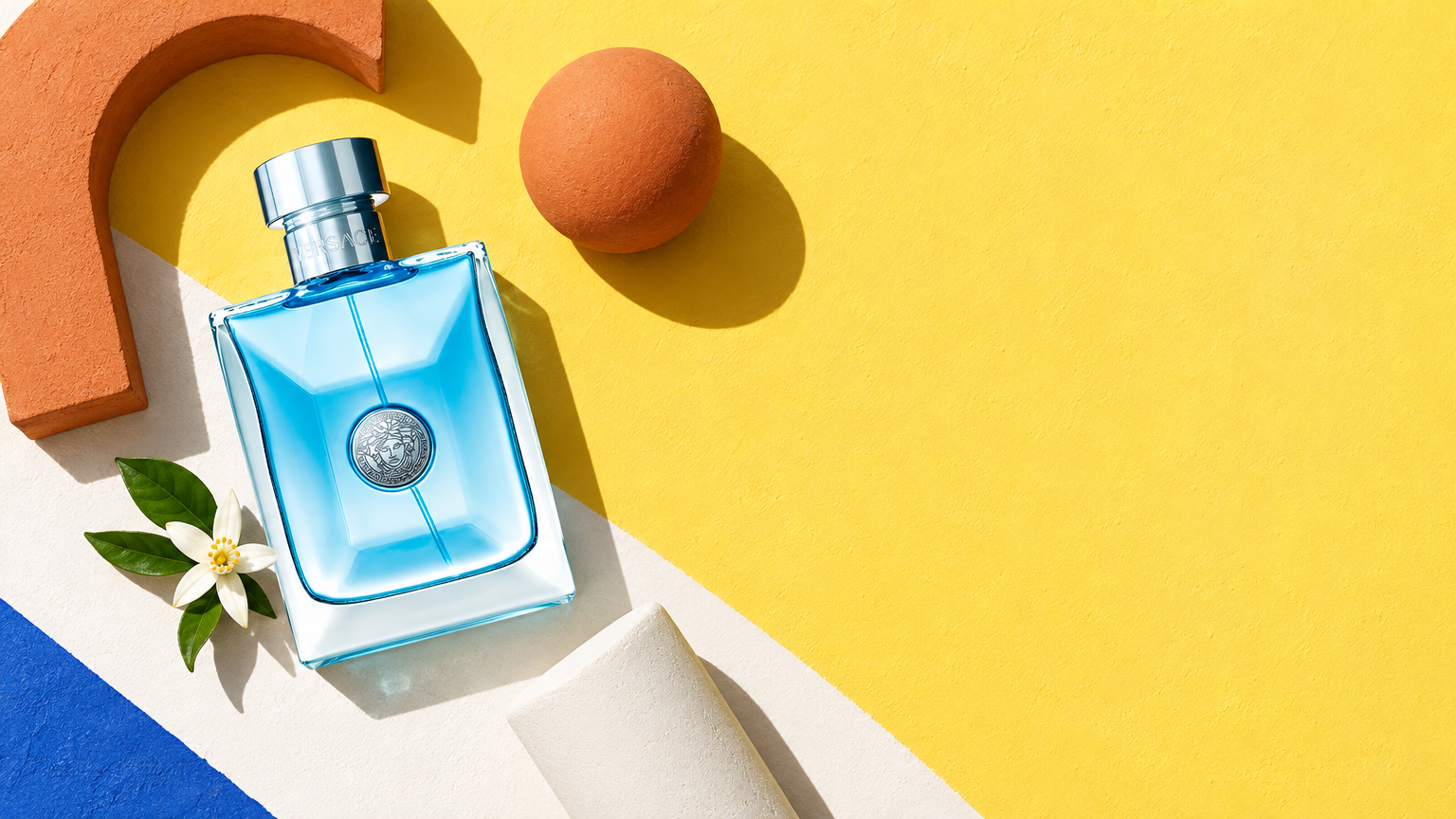
Versace Pour Homme is a direct use of the phrase: no flanker name, no extra word, just the brand and "for men". Alberto Morillas composed it in 2008. The verdict on our page is Favourite: citrus and neroli bring a bright opening, rose softens the edge, and aromatic herbs settle over musk, tonka and amber. It is the kind of Eau de Toilette that earns "pour homme" by being an easy daily wear rather than a statement piece.
On the other side of the same phrase sits Versace Eros Pour Femme, a 2014 Eau de Parfum by Morillas, Olivier Cresp and Nathalie Lorson. The verdict is Favourite: bold, bright and more floral than the Eau de Toilette, with lemon and pomegranate sparkle, jasmine and peony in the heart, and musk with sandalwood for depth. The name follows the same pattern as Versace Pour Homme, flipped: femme instead of homme.
L'Eau d'Issey Pour Homme by Issey Miyake stacks two of the terms above into one name: l'eau ("the water") and pour homme. Jacques Cavallier-Belletrud composed it in 1994. The verdict describes a crisp, iconic aquatic citrus that still feels modern, and the "eau" is doing real work: the whole point is a light, water-cool freshness rather than a heavy statement.
Dior Homme Intense shows what "intense" tends to mean in practice. François Demachy composed this Eau de Parfum in 2011. The verdict is Statement: cool lavender meets powdery iris, then settles into dry vetiver and smooth cedar. The word "intense" is selling a richer mood, not just a bigger number.
Jean Paul Gaultier Scandal Pour Homme Absolu pairs pour homme with absolu. Quentin Bisch, Nathalie Gracia-Cetto and Christophe Raynaud share the 2024 credit. The verdict describes a decadent, woody-gourmand statement with plush caramelised warmth and nutty depth, taken up to Parfum strength. Absolu is the word doing the selling; Parfum is the concentration actually printed on the box.
Versace Crystal Noir shows noir doing mood work rather than colour work. Antoine Lie composed this Eau de Parfum in 2004. The verdict is Statement: pepper, ginger and cardamom meet creamy gardenia, coconut and warm woods. Nothing about the liquid is black: noir here means "dark" in the emotional, after-dark sense the word carries across perfume names.
Common questions about pour homme and pour femme
Is the H in "pour homme" really silent?
Yes. French treats the H in homme as a silent h muet, so the word lands closer to "om" than "home". Wiktionary's French entries give homme as /ɔm/ and femme as /fam/. Said naturally, "pour homme" comes out as "poor om", not "poor home".
What does "pour femme" mean on a perfume bottle?
It means "for woman". Pour is French for "for" and femme is "woman", so pour femme is the direct counterpart to pour homme. It appears on exactly the same kind of bottle: a marketing label, not a fragrance family or a strength.
What does pour femme perfume smell like?
There is no single smell. In our catalogue the 229 perfumes with pour femme in the name most often list jasmine and musk, then vanilla, bergamot and rose, but the label alone does not narrow the smell down any further.
Can women wear a "pour homme" fragrance, and vice versa?
Yes. "Pour homme" and "pour femme" describe how a house chose to market a scent, not a property of the notes inside it. If the description and notes appeal to you, the label on the box is not a reason to skip a bottle.
What does "l'homme" mean?
It means "the man". Like "pour homme" it is a naming convention, and in our catalogue 80 of the 91 perfumes with it in the name are masculine and 11 are unisex.
What is the difference between "eau" and "eau fraiche"?
"Eau" just means "water" and turns up in every "Eau de ..." name on the shelf. "Eau fraiche" specifically means "fresh water" and points to a very light style, built for warm weather and a close-to-skin trail rather than for lasting power.
What is the difference between Parfum and Eau de Toilette?
Parfum is the stronger concentration and Eau de Toilette the lighter. The full ladder, with real examples, is in our Eau de Parfum vs Eau de Toilette guide.
How we know
The counts, notes and verdicts above come from our own catalogue, read on 24th November 2026, with the verdicts compiled from wearer reports rather than manufacturer copy. Pronunciations follow the French entries for homme and femme on Wiktionary, read the same day. For the full method, see our methodology. For what "Elixir" really changes, bottle by bottle, see What Is an Elixir Perfume?