
Brut
EDP
Fabergé
Favourite
Historic mass-market fragrance name best known for bold 60s-70s style masculines and splashy mainstream launches.
Fabergé as a fragrance and toiletries brand traces back to 1922, when F. Eugène Fabergé and Alexander Fabergé established Parfums Fabergé in Paris to produce toiletries and related products. In 1936, the business expanded to the United States with the creation of Fabergé Inc in New York in association with Samuel Rubin, who registered the Fabergé Inc name in 1937 for perfumes and toiletries. Through the 1940s to 1970s the company developed a portfolio of mass-distributed fragrances and grooming products that leaned heavily on bold, attention‑grabbing compositions rather than discreet luxury positioning.
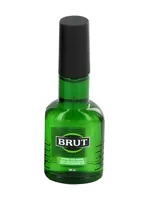
In the 1960s and 1970s, Fabergé helped define the mainstream masculine and feminine scent landscape with launches like Brut (1964), which became a widely recognized fougère for men, and Babe (1976), a women's fragrance that in its first year became Fabergé's largest‑selling women's perfume worldwide and won Fragrance Foundation awards for both its launch success and advertising campaign. Babe was fronted by model and actress Margaux Hemingway, who reportedly signed a $1 million contract to promote the scent.
Corporate ownership of the Fabergé name shifted several times. Samuel Rubin sold Fabergé Inc to Rayette in 1964, which later evolved into Rayette‑Fabergé. The brand's fragrance division was re‑emphasized in 1982 with a dedicated unit to market its then 13 major fragrance lines. In 1989, Unilever acquired Fabergé Inc for about US$1.55 billion, and subsequent restructuring folded the portfolio into larger personal care operations; today, the Brut line remains one of the most visible surviving Fabergé‑originated fragrances under Unilever's umbrella.
A mass market, mid house known for aromatic fougère compositions.
Fabergé moved from Parisian toiletries in the 1920s to a mass‑market American fragrance player by mid‑century, with heavy emphasis on bold masculines and accessible feminine scents. The 1960s and 1970s were its creative peak in popular consciousness, driven by launches like Brut and Babe and aggressive advertising. After a chain of corporate sales culminating in Unilever's 1989 acquisition, the Fabergé name largely receded as a standalone fragrance brand, with key lines such as Brut living on under the parent company's broader personal care portfolio rather than as part of a coherent Fabergé house identity.
Fabergé is less a living perfume house today than a historical label attached to a few surviving products, but its vintage hits still interest collectors and fans of retro, no‑nonsense scent styles.
Favourite - easy to wear anywhere · Statement - bold & distinctive · Acquired - bold, for fewer occasions
New finds, honest verdicts, and price drops.
No spam. Unsubscribe anytime. See our privacy policy.