
The Beginner's Guide to Fragrance
In this guide
What perfume actually is
Strip away the fancy bottles and the marketing, and perfume is surprisingly simple: fragrance oils dissolved in alcohol, with a tiny amount of water. Three ingredients. The rest is craft, chemistry, and a few hundred years of people working out which combinations work.
The oils do the work. Some are natural - flowers, woods, resins, citrus peels, spices. Others are synthetic, created to replicate nature or produce scents that don't exist anywhere else. Most modern perfumes use both. The alcohol acts as a delivery system - when you spray, it evaporates and carries those fragrance molecules into the air. It's what makes perfume project.
The concentration of oil to alcohol is what gives you your Eau de Toilette, Eau de Parfum, and Parfum labels - we've got a separate guide on concentrations if you want the full breakdown.
One thing worth knowing early: perfume isn't static. It changes over time on your skin as lighter molecules burn off and heavier ones emerge. Perfumers design for this, building fragrances in layers called notes. Understanding them changes how you think about fragrance entirely.
How fragrance works on your skin
A perfume can smell completely different on you than on your mate. That is your skin chemistry. Your pH, your skin's oil content and even your diet all interact with fragrance molecules, and the combination is yours.
- Oilier skin holds fragrance longer because oils slow evaporation
- Drier skin lets lighter notes vanish faster, so you reach the heart and base quicker
- Diet and medication can subtly shift how a fragrance reads on you over time
Where you spray matters too. Pulse points - wrists, neck, behind the ears - are warmer because blood vessels sit closer to the surface, and heat helps fragrance project. More important than hitting every pulse point: don't rub your wrists together. Rubbing generates friction that crushes the top notes and fast-forwards you past the opening the perfumer designed.
Spray on pulse points - wrists, neck, behind the ears - but never rub your wrists together. Rubbing crushes the top notes and shortens the life of your fragrance. Just spray and let it dry naturally.
You can also spray on clothes - fabric holds fragrance longer, but the scent won't develop and change the way it does on skin. Try both and see where you land.
The four main fragrance families
Almost every fragrance falls into one of four broad families. Once you know which you are drawn to, you can ignore most of a shop and focus on what you will actually like.
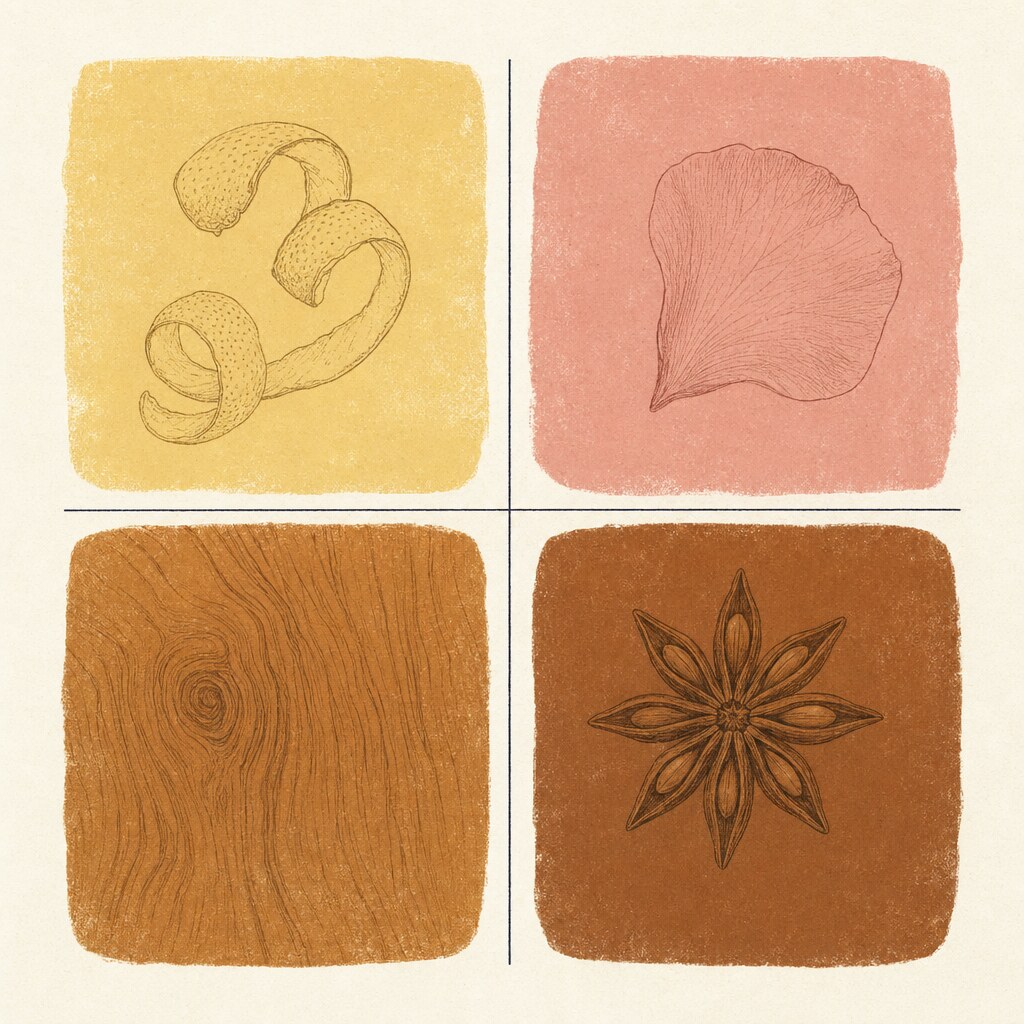
- Fresh - Citrus, green, aquatic, ozonic. Light, clean, and energising. Think just-cut grass or a freshly sliced lemon. Great for warm weather and everyday wear, though they tend to be the least long-lasting. Example: Dior Sauvage's bergamot and pepper opening.
- Floral - The biggest and most diverse family. Ranges from soft, powdery iris to dark, intoxicating tuberose. Do not write it off as flowery: florals run from romantic to green to intense. Example: Prada L'Homme's powdery iris.
- Woody - Sandalwood, cedar, vetiver, oud. Warm, grounding scents that sit closer to the skin. Excellent longevity because dense wood molecules evaporate slowly. Example: Tom Ford Oud Wood.
- Oriental (Amber) - Rich, warm, often sweet. Vanilla, amber, incense, exotic spices. These fill a room and leave a trail. Typically evening and cold-weather fragrances, though if you like it, wear it. Example: YSL Black Opium's coffee and vanilla.
Most perfumes blend elements from multiple families - a "woody oriental" or "fresh floral" is common. The families are a starting point, not rigid boxes. Our guide to accords explains how perfumers blend these elements together.
How to test perfume properly
A little patience here saves you a lot of money. What you smell in the first thirty seconds is mostly alcohol and top notes, and it tells you almost nothing about the rest of the day you will wear it.
- Spray two fragrances max on skin - one on each wrist. Use paper blotter strips to screen extras, but blotters don't interact with your skin chemistry so they're unreliable for a final decision.
- Leave the shop. Come back to your wrists in twenty minutes, then an hour, then two hours. You're waiting for the base to emerge - that's what you'll actually smell like all day.
- Get samples before buying full bottles. Most niche brands sell discovery sets, and online retailers sell 2ml or 5ml decants for a couple of quid. Living with a fragrance for a few days tells you far more than a single shop test.
Test no more than two fragrances on skin at a time, and give each one at least two hours before deciding. The opening is just the introduction - the drydown is where you find out what you'll actually smell like all day.
Building your first collection
Resist the temptation to buy everything at once. Three or four well-chosen bottles will serve you better than fifteen impulse purchases - and your taste will develop over time.
A solid starting collection covers three scenarios:
- An everyday workhorse - versatile, not too loud, office-appropriate. Bleu de Chanel, Prada L'Homme, Versace Pour Homme.
- A going-out fragrance - bolder, more projection, more personality. Lean into oriental and woody families here. Dior Homme Intense, YSL La Nuit de l'Homme.
- A warm-weather option - light and fresh. Acqua di Gio, Dolce & Gabbana Light Blue, or a clean citrus like Atelier Cologne Clementine California.
As you wear these, you'll notice what you reach for most and what gaps you feel. That's when you make more targeted purchases. Avoid blind buying at first - smell it on your skin before committing.
Budget matters too. Some of the most complimented fragrances cost under twenty-five pounds - Nautica Voyage, Montblanc Explorer, Afnan Supremacy Not Only Intense. Good perfume doesn't have to be expensive.
Common beginner mistakes
Everyone makes these. They're not catastrophic, but avoiding them saves money and frustration.
- Buying based on someone else's opinion. Fragrance is subjective in a way most products aren't. Your skin, your memories, your preferences all shape the experience. Recommendations are a starting point - your nose is the final judge.
- Overspraying. Fragrance should be discovered, not announced. Two to four sprays is plenty for most Eau de Parfums - wrists, neck, maybe chest. If people can smell you from across the room, you've used too much.
- Storing perfume badly. Heat, light, and humidity degrade fragrance oils. Skip the bathroom shelf and windowsill. Keep bottles in a cool, dark place - a drawer, wardrobe, or the original box. Well-stored perfume lasts five to ten years; badly stored, it can turn in eighteen months.
- Chasing compliments over personal enjoyment. The best fragrance is one you enjoy smelling on yourself throughout the day. Compliments are a bonus, not the point.
- Thinking expensive means better. Price reflects brand positioning and marketing, not necessarily quality. Sample widely across price ranges before you assume you need to spend big.
- Nose fatigue. After about thirty minutes, you'll stop being able to smell your own fragrance. That's normal - it's called olfactory fatigue. Don't re-spray. Other people can still smell it perfectly well.
If you can't smell your perfume after thirty minutes, that's normal - your nose has adapted. Don't re-spray. Other people can still smell it perfectly well.
Start with a few samples, pay attention to what you keep reaching for, and build from there. Our guide to perfume notes is the natural next step. And if you want to see fragrance from a completely different angle, discover ScentArt - we turn perfume notes into generative art.