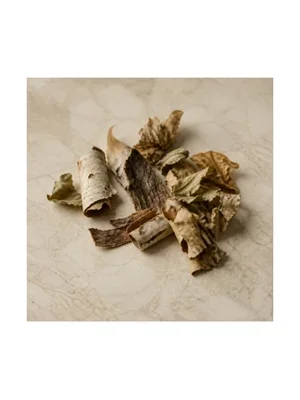
Aspen
Note Profile
About
Aspen is a pale wood note with the weight taken out. One trade glossary describes it as papery and skeletal, a wood defined by what it does not have: no resin, no smoke, no cream. It is a synthetic accord, not an extract, and it is used to make other woods feel thinner and colder.
Scent Profile
Dry_woody leads and it is a stripped wood, not a rich one: pale, papery bark with nothing balsamic behind it. Green sits for the cold, wet-bark freshness the source names, and for the cis-3-hexenol in the build. Mineral carries the word the source uses for the whole effect, 'transparent, almost mineral' - the sense of cold stone and altitude rather than of vegetation. Clean_musk is the white musk the source lists as a standard part of the accord, giving it skin-proximity and softness. Below: phenolic for the faint medicinal quality the source names twice, once in the wild plant - quaking aspen bark 'smells faintly medicinal (salicin, the aspirin precursor)' - and once in the build, which buys the effect back with 'traces of salicylaldehyde (medicinal-bark character)'. Nothing else was holding that quality, so nothing comes down: dry_woody and mineral were scored for the pale-wood and transparent claims. Also below: aromatic_herbal for the aromatic-woody family the source places it in, aquatic_ozonic for the wet half of 'cold, wet-bark', and cooling_mentholic for the cold-air impression. The peppery-vanilla scent of the male flower hydrosol is not scored, because the source flags it as an analytical curiosity outside commercial use.
ScentWheel
Read off the wheel, not a label applied to the note.
Origin
No essential oil, absolute or CO2 extract of Populus tremuloides is sold for fine fragrance. Bark extracts of the tree exist (CAS 90083-05-9) but are made for cosmetics, where salicin acts as a preservative, not for their odour. The perfumery note is built. The one trade source found names the usual parts: cis-3-hexenol for cut-stem green, a trace of salicylaldehyde for medicinal bark, Iso E Super at low dose for woody radiance, and white musks to hold it against skin. Aspen is not poplar bud absolute (Populus nigra), which is a real material and smells balsamic, honeyed and leathery. The same source calls that one the olfactive opposite.
Usage in Perfumery
A heart-register modifier. It lightens heavy woody bases and puts cold air into a composition, working as contrast against sandalwood, oud and other dense materials rather than as a subject in its own right. Fragrantica records 3 placements. Parfumo records none.
Similar Notes
Perfumes featuring Aspen
A selection of reviewed perfumes where Aspen appears prominently.
No perfumes featuring this note have been reviewed yet. Check back soon.