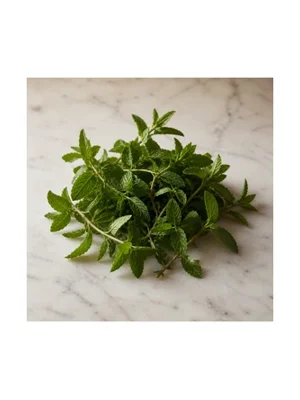
Brazilian Mint
Note Profile
About
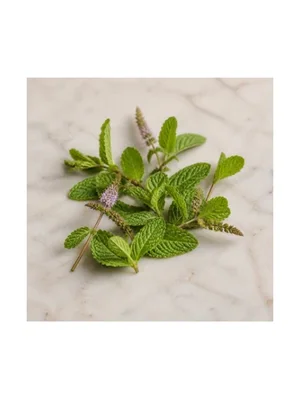
Mojito mint: milder and more citrus-sweet than spearmint, with the fruity, apple-leaning wash it gets from its other parent, apple mint. Grown and sold internationally under its own name for the cocktail it is named for.
Scent Profile
Citrus leads, named independently across grower listings as 'hints of citrus' and 'citrus undertones' that mark this mint off from plain spearmint's grassier sweetness. Fruity follows: the same trade sources describe 'a subtle apple note inherited from its parent species' and 'a soft hint of fruit', which traces straight to the apple-mint (M. suaveolens) parentage and to the rotundifolone the Brazilian studies measure at 63.5-71% of the leaf oil - the identical compound already credited, under its other name piperitenone oxide, for apple mint's own fruity character. Aromatic_herbal sits, the ordinary Lamiaceae herb body shared by every mint in this vocabulary. Cooling_mentholic is real but held, under spearmint's 0.42 and far under peppermint's 0.85, because every nursery source that mentions it does so by contrast: 'much milder flavor', 'lacking the sharp, medicinal camphor-like bite of peppermint or standard spearmint', a 'smooth fragrance... combining the crisp coolness of mint with a soft hint of fruit'. Sweet_vanillic is the mild sweetness those same sources describe as 'agreeably mild and warm, not... overly sweet' - present, but explicitly not pushed further. Green is the plain leaf note underneath.
ScentWheel
Read off the wheel, not a label applied to the note.
Origin
Mentha x villosa, the natural hybrid of spearmint (M. spicata) and apple mint (M. suaveolens), grown and sold as 'mojito mint' or 'Cuban mint'. It is a triploid with 2n=36 chromosomes; its spearmint parent is itself reported as either triploid (2n=36) or tetraploid (2n=48) depending on the population, so the ploidy split between the two is real but less clean-cut than a single number suggests. Academic studies of the plant as cultivated and studied in Brazil (Federal University of Ceara and Paraiba) find its essential oil dominated by rotundifolone - the same compound apple mint's own dossier credits with that species' fruity-ester character, there called piperitenone oxide - at 63.5-71%, with limonene, trans-caryophyllene and beta-pinene as minor constituents. A 2025 phytochemistry review notes the chemotype of M. x villosa tracks geographic origin: some populations run rotundifolone-dominant like the apple-mint parent, others carvone-dominant like the spearmint parent.
Usage in Perfumery
A fresh top note for cocktail-adjacent and citrus-mint compositions where plain spearmint or peppermint would read too sharp. Nursery and horticultural trade sources are unanimous on why it is grown at all: the appeal is the absence of a 'sharp, medicinal camphor-like bite'.
Similar Notes
Perfumes featuring Brazilian Mint
A selection of reviewed perfumes where Brazilian Mint appears prominently.
No perfumes featuring this note have been reviewed yet. Check back soon.