The Workbench
Record what you blended from a kit and read it back. The Workbench takes the materials and the amounts, resolves them into the notes we hold, and gives you an estimated scent wheel, a modelled six-hour drydown, and the perfumes whose profiles sit closest to what you made.
You need a physical blending kit, and it has to be one we have mapped. Without one there is nothing to record, though the notes directory is open to everybody.
What you get
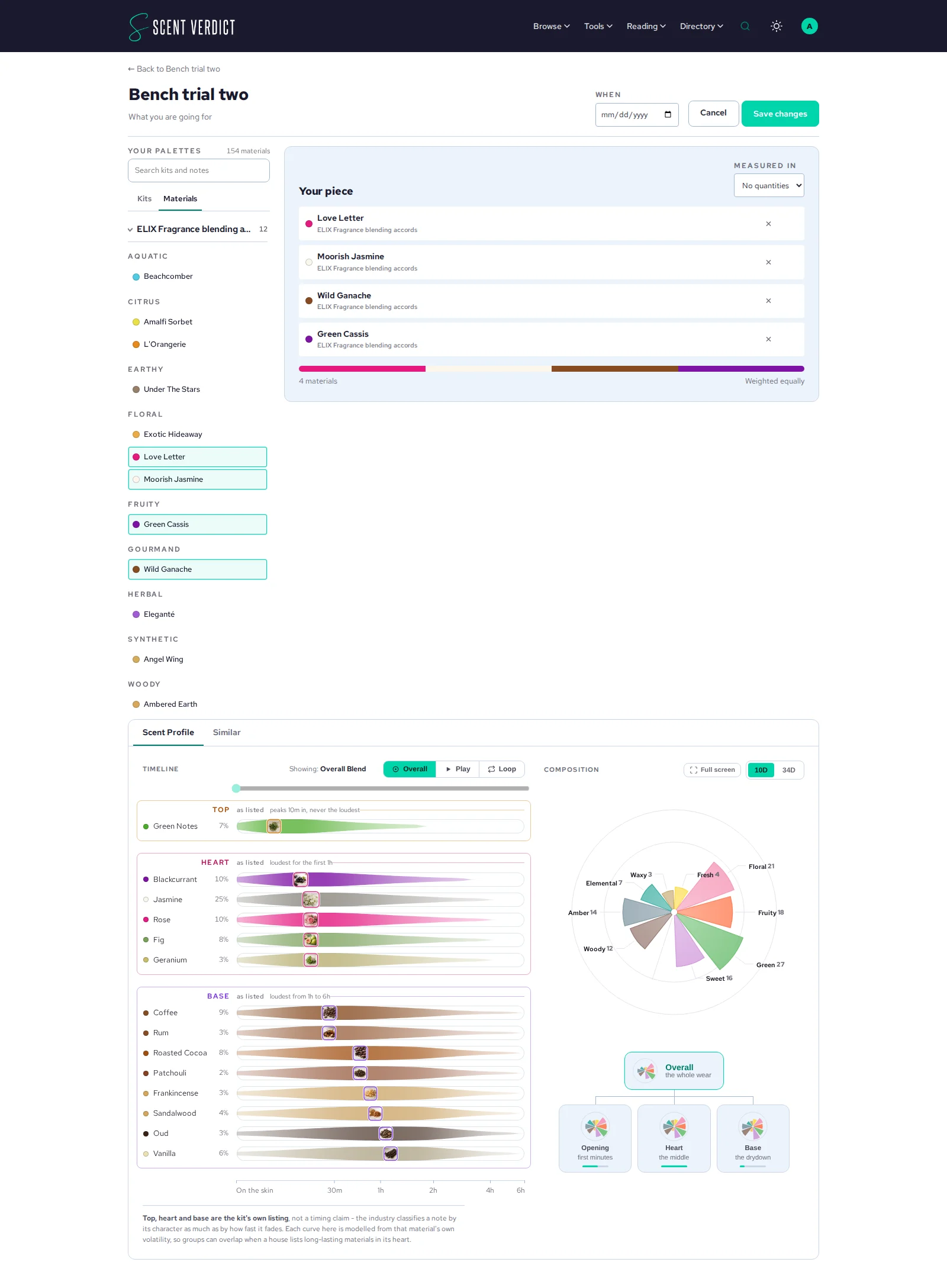
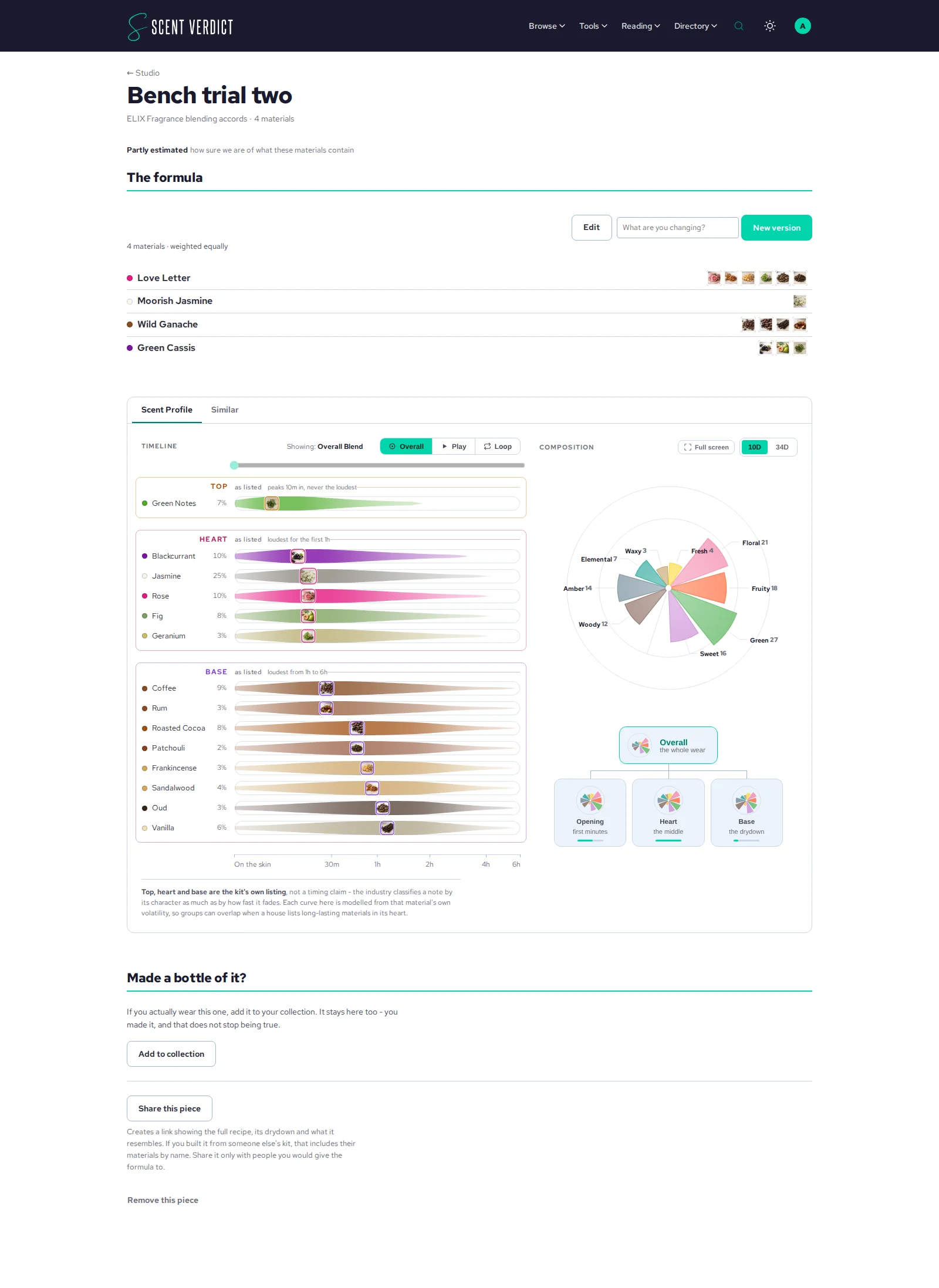
Both screens below are a real piece, built from four materials in an ELIX Fragrance kit. The wheel, the timeline and the profile matches are all computed from those four names and their amounts.
Building it
On the website, your kits sit down the left, grouped by the character we mapped each material to, so you can find one by what it smells of rather than by remembering its name. Pick the materials you used and set how much of each, or leave the amounts out. The wheel and the drydown underneath redraw as you go, so you are not waiting until the end to find out what you have made.
Reading it back
The formula, and how sure we are of it
A piece is a list of materials from your kit and how much of each you used. Leave the amounts out and we split them evenly, and say so, because everything after that is computed from the split and you should know when it was assumed rather than chosen. Each material shows the notes it resolved to, so you can see what the Workbench thinks you actually put in. The confidence line reports how sure we are of the mapping, which depends on how precisely the kit's maker describes each material.
Its character, on the scent wheel
The same ten-family, thirty-four-facet wheel every perfume on the site is drawn on, so your blend is plotted in the identical vocabulary and you can hold it against anything we publish. Switch between the ten families and the thirty-four facets, or open it full screen.
Its estimated development, hour by hour
Every note gets its own curve across six hours, grouped into the top, heart and base the kit itself lists. The grouping is the maker's, not a timing claim of ours, and the curves are modelled from the notes we mapped each material to, so the groups overlap where a house puts a long-lasting material in its heart. Nothing here is measured from your bottle.
The closest mapped profiles we hold
We compare your blend's mapped profile against the perfumes we hold and show the closest, with the verdict and price tier we already give each one. This is a sanity check rather than a score: it asks whether you landed near what you meant. A close profile does not establish that two things smell alike.
Versions, your collection, and sharing
Editing a piece saves over it. Starting a new version keeps the old one alongside a note of what you changed, so an iteration survives rather than the last edit winning. If you actually wore one, add it to your collection and it stays there as something you made.
Kits we have mapped
A blending kit is a physical set of scented materials you combine yourself. The Workbench reads a blend through the kit it came from, so a kit has to be mapped first: each provider publishes what is in theirs, and we map every one of those materials onto the notes we hold. Each kit page links out to the provider who sells it, and several of them run workshops if you would rather be taught than read.
-
 Maison 21G
Leans animalic, leather, green ·
68 materials, 72 mapped notes · Maison 21G -
 EveryHuman
Leans fresh, synthetic, aquatic ·
52 materials, 78 mapped notes · EveryHuman -
Perfumery Art School Certificate kit
Leans spicy, amber, citrus ·
40 materials, 46 mapped notes · The Perfumery Art School UK · students unlock it with a code from their school -
Perfumery Art School Diploma kit
Leans spicy, amber, citrus ·
40 materials, 46 mapped notes · The Perfumery Art School UK · students unlock it with a code from their school -
 The Perfume Studio
Leans musk, fruity, citrus ·
29 materials, 78 mapped notes · The Perfume Studio -
 ELIX Fragrance blending accords
Leans synthetic, aquatic, musk ·
12 materials, 44 mapped notes · ELIX Fragrance -
 Experimental Perfume Club Essentials
Leans musk, resin, green ·
9 materials, 38 mapped notes · Experimental Perfume Club
The mapping is our interpretation of how a material is described, not a reading of what is in it. We have not analysed these materials and we hold nobody's recipe. Where a name suggests more than one character we map it to several notes with relative weights, and each of those carries a confidence we assigned. Independent analysis: we are not affiliated with, or endorsed by, any of these providers.
What it is not
Results are estimates from our reading of the materials, not measurements of your blend. It will not tell you what to make, and it cannot tell you whether what you made is any good. Nothing here establishes ingredients, allergens or safe dilution - for that, follow your kit provider's own instructions.
Your blends are yours
A blend is private to your account by default, and nothing you build enters the public catalogue. Sharing one creates a link, and anyone holding it can see the full recipe, its drydown and what it resembles, including the kit materials by name. Share it only with people you would give the formula to.