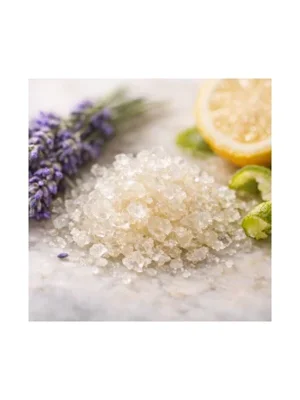
Helional is a synthetic aldehyde aroma chemical renowned for its watery-fresh, ozonic profile with green-floral cyclamen and subtle hay nuances. Introduced in the late 1960s, it revolutionized aquatic perfumery by providing a modern marine freshness. It functions as a diffusive top-to-heart note with mild fixative properties.
Scent Profile
Helional opens with a brisk ozonic burst evoking sea breeze and coastal air, quickly revealing green cyclamen floral tones and a crisp melon facet. It evolves into a softer watery freshness underpinned by new-mown hay and faint leafy warmth. The overall character is clean, airy, and invigorating without heaviness.
Read off the wheel, not a label applied to the note.
What this is made of
3-(1,3-benzodioxol-5-yl)-2-methylpropanal
Names this molecule
CAS 1205-17-0
CORRECTED 2026-08-14: this edge said the material was not held, and it is - as '1205-17-0' (CAS 1205-17-0). The gap was in the LOOKUP, not the catalogue: we store this molecule under its systematic or registry name, the edge was authored against the trade name, and nothing matched. Supplier catalogues published the CAS and PubChem confirmed it (CID 64805). Previously: A real aldehyde we do not hold. The material that would realise this note is helional; we do not hold it, so this edge names the gap rather than asser
Restricted
An IFRA Standard limits how much of this a perfumer can usethe limit applies to the perfumer, not the wearer
These are facts about the substance, not about any perfume with this note.
Why that matters
A perfume that names Helional can use a different extract, a
reformulated version, or a synthetic reconstruction. It can also hold less
than the amount that requires a declaration. We cannot tell which applies.
These rows cover only the substances we hold a link for.
Helional is a fully synthetic compound (CAS 1205-17-0) produced via multi-step processes from petrochemical feedstocks, resulting in the aldehyde 3-(1,3-benzodioxol-5-yl)-2-methylpropanal. Developed in the late 1960s, originally derived from heliotropin structures, it is manufactured by major firms like IFF. No natural sources exist, making it vegan and consistent in quality.
Usage in Perfumery
Perfumers employ Helional in top-to-heart positions at 0.5-2% for aquatic, ozonic, and marine accords, enhancing diffusion and extending top notes. It blends seamlessly with cyclamen aldehydes, hedione, green ionones, musks, and light woods in fine fragrances. Higher levels emphasize hay-metallic edges, while trace amounts add subtle airy lift to florals.
We count visits to see which pages help people and to improve the site.
No advertising, and no tracking across other sites.
Read our cookie policy
Cookie Preferences
Analytics is on unless you switch it off here. Essential cookies cannot be
disabled as they're required for the website to function.
Always On
Required for the website to function. Includes session management and security tokens.
Counts visits and which pages people use, so we can improve the site. We use
Google Analytics with its advertising features switched off, plus our own
cookieless visit counter. Switching this off stops both.