Safflower names no single substance
ReconstructedSafflower oil is a fixed carrier oil with no odour.
Note Profile
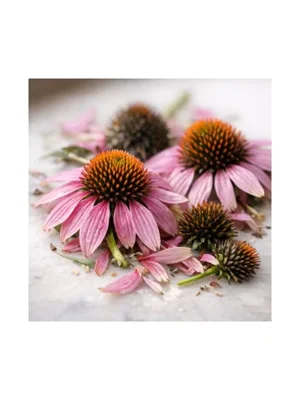
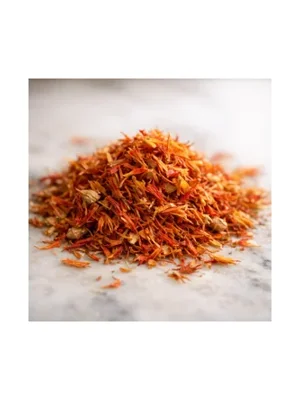
Safflower comes from the dried petals of Carthamus tinctorius, grown mainly in Asia and the Mediterranean. The petals are used directly or solvent extracted to make a floral absolute. It barely smells. There is a faint, dusty, papery dryness over a mild green-herbal background, closer to sun-faded botanicals than to a flower. It has almost no floral sweetness and works as a modifier.
Safflower barely smells at all. What is there is a faint, dusty, papery dryness over a mild green-herbal background, closer to sun-faded botanicals than to a flower, with a dry hay-like edge. Underneath sits a weak fatty-waxy aldehyde tone: hexanal ('green, grassy, fatty') and nonanal ('waxy, citrus, oily') are the two most abundant volatiles in the GC-IMS work. There is almost no floral sweetness. The note works as an atmospheric modifier rather than as a flower anyone would recognise.
Read off the wheel, not a label applied to the note.
Safflower oil is a fixed carrier oil with no odour.
Safflower is derived from the dried petals of the Carthamus tinctorius plant, cultivated mainly in Asia and the Mediterranean. The petals are typically harvested and either used directly or subjected to solvent extraction to obtain a floral absolute.
Perfumers use safflower primarily as a supporting floral note in the heart of fragrances, where it adds lift and subtlety without overwhelming other ingredients. It blends well with tea notes, light musks, and other soft florals, contributing to transparent and luminous accords.
A selection of reviewed perfumes where Safflower appears prominently.
New finds, honest verdicts, and price drops.
No spam. Unsubscribe anytime. See our privacy policy.