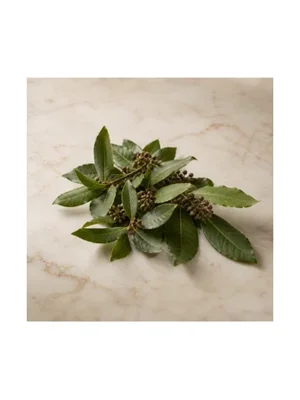
California Bay Laurel
Note Profile
About
California bay laurel is the crushed leaf of Umbellularia californica. It is not the culinary bay of the kitchen. It smells sharply camphoraceous first, with a bay-like herbal body under it. Every source that compares it to Mediterranean bay says the same thing: it is the same kind of smell, much stronger. One horticultural source reports that inhaling a single crushed leaf can bring on a headache, which is why the tree is also called the headache tree.
Scent Profile
Cooling_mentholic leads and it is the one claim all three sources make in the same words. Wikipedia: 'a pungent scent resembling camphor when bruised, due to a chemical known as umbellulone'. CNPS: 'a pungent odor... this odor is due to the oils present in the leaves, which contain up to 40% umbellulone'. It is set above the published camphor-tree at 0.82, because that is a whole-timber distillate diluted by sesquiterpenes, and below the crystalline camphor at 0.90, because this is still a leaf with a plant body around the ketone. Aromatic_herbal is second, on the comparison every source reaches for. CNPS is the clearest: 'a pungent odor reminiscent of the bay leaf of culinary fame but typically with a much stronger scent'. It sits below the published bay-leaf at 0.65 on purpose, because the sources say the herbal read is what this shares with bay while the camphor is what makes it different, so the ordering of the two facets flips relative to bay-leaf. Warm_spice rests on one word: Wikipedia's 'a somewhat stronger camphor/cinnamon flavor compared to the Mediterranean bay'. That is a flavour sentence, not a scent one, and one word is thin, so it is scored low with a spread. Green is not stated by any source. It is carried across from the material being a fresh leaf crushed in the hand, and from the published laurel (0.28) and bay-leaf (0.30) both holding it. Zeroing it because these three botanical sources did not think to write 'green' would be asserting an absence nobody claimed. Below the line: fresh_spice comes only from the common name pepperwood and from umbellulone reading as pungent rather than sweet, which is weak evidence and carries a spread; dry_woody covers the bark, which Wikipedia says holds the same scent; amber_resinous is a floor for the resinous cast of a Lauraceae leaf oil.
ScentWheel
Read off the wheel, not a label applied to the note.
Origin
Umbellularia californica, Lauraceae, an evergreen tree of the California Coast Ranges and southern Oregon. The California Native Plant Society names the compound and the concentration: the leaves 'contain up to 40% umbellulone, an aromatic ketone compound'. Umbellulone is not the dominant compound of Laurus nobilis oil, so this is a different genus with a different lead chemical, not a regional cut of the published 'laurel' or 'bay-leaf'. Wikipedia says 'the bark and leaves have a pungent scent resembling camphor when bruised', so the bark carries it too, but the leaf is what is picked and crushed. The tree also goes by pepperwood, Oregon myrtle, myrtlewood and headache tree. None of those resolve to a published note that is this plant: 'myrtle' is Myrtus communis and the alias 'Pepperwood(TM)' points at 'pepper' and is a trademarked captive, so neither is a synonym collapse.
Usage in Perfumery
A hard camphoraceous top accent. Attested on 2 Parfumo entries across 2 brands and absent from Fragrantica, so it is a Parfumo-side term with low usage. No perfumery supplier or trade house page describing a California bay laurel oil for fragrance use could be reached, so its working position is read from the plant rather than from a bottle.
Similar Notes
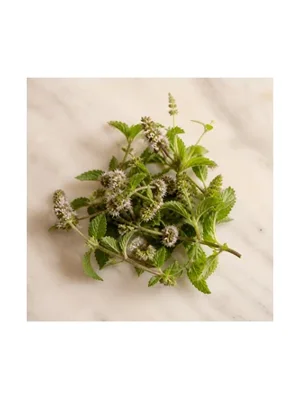
Perfumes featuring California Bay Laurel
A selection of reviewed perfumes where California Bay Laurel appears prominently.
No perfumes featuring this note have been reviewed yet. Check back soon.