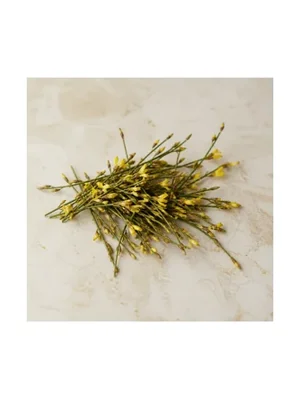
Dyer's-Broom
Note Profile
About
Dyer's-broom is a dry green note, cool and bracken-like. It is not the honeyed broom of genet absolute, and the two should not be swapped.
Scent Profile
Green leads on the only olfactive sentence ever published for this plant. The Perfume Society writes that it is 'dry, cool and bracken-like, adding a green feel to a scent'. Every other value here is read out of that one sentence. Tobacco_hay is 'bracken-like' plus 'dry'. Dried fern reads as hay in this vocabulary, and the word dry is the reason it is a hay reading and not a damp one. Aromatic_herbal is the herbaceous body of a leafy shrub, at the lowest value worth naming. Below: mossy_chypre is the woodland-undergrowth side of bracken, held below the published fern note's 0.45 because fern is 'fresh, damp' and this source insists on dry. Cooling_mentholic is the word 'cool', which reads as temperature more than as menthol, so it stays at trace. Earthy and dry_woody are the same undergrowth reading at trace. Floral and honeyed are the smallest values that still admit this is a yellow pea-flowered legume. They are not zero, because nobody has stated that the flowers are odourless. They are nowhere near the published broom note's honeyed, because the one trade source that discusses both plants gives the honeyed, narcotic, tobacco-edged character to Spartium junceum and not to this one.
ScentWheel
Read off the wheel, not a label applied to the note.
Origin
Dyer's-broom is Genista tinctoria, the same plant as dyer's greenweed. Every horticultural source checked uses the two names for one species. It is a different genus from Spartium junceum and Cytisus scoparius, the plants behind the published broom note. Genista tinctoria was grown for a yellow textile dye, not for scent, and no extraction method, absolute or supplier could be found for it. One perfumery glossary states outright that only Spartium junceum is used for genet and that Genista tinctoria 'should not be confused' with it. Two real perfumes credit the note anyway: Azzaro 9 (1984) and Boucheron Trouble (2004).
Usage in Perfumery
A green top note in two perfumes, three decades apart. Parfumo records it in the top of the pyramid. Use it where a dry fern-like green is wanted without the sweetness that broom brings.
Similar Notes
Perfumes featuring Dyer's-Broom
A selection of reviewed perfumes where Dyer's-Broom appears prominently.
No perfumes featuring this note have been reviewed yet. Check back soon.