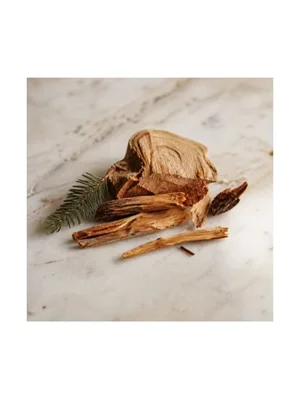
Fir Tree Wood
Note Profile
About
Fir tree wood is scored as the timber of a true fir, not as the needle oil and not as the balsam. Parfumo lists Fir, Fir needle, Fir balsam and Fir tree wood as four separate terms, so the databases already draw the line this note sits on. Every perfumery trade description found for 'fir' turns out to describe fir balsam absolute or fir needle oil, both extracted from twigs and needles. ScenTree says so directly: 'The fragrant principle of the tree is contained in the twigs.' Those materials are already published here as fir, fir-resin and canadian-fir-balsam. Wood tissue smells different from needle oil. It is dominated by fatty-acid breakdown products and lignin phenolics rather than by the terpenes that give needles their sharp green lift. The vector follows that split and lands quiet, sweet and dry rather than green and resinous.
Scent Profile
Dry_woody leads because the referent is timber and three of its four placements are in the base. It is held just below pine-wood at 0.62 and far below buddha-wood at 0.78, because fir is a low-odour softwood and the one study that measured it found faint compounds rather than loud ones. Sweet_vanillic is vanillin, named by Schreiner et al. as one of the dominant odorants of the softwood panel that included white fir, and a citing paper ties the panel's vanilla-like impression to it. Amber_resinous is the resin any conifer board carries. It is set at under half of pine-wood's 0.72 because Abies wood lacks the normal resin canals that pine wood has, and the fir tree keeps its balsam in bark blisters instead. Green is hexanal, the panel's grassy odorant, and it is a fraction of fir's own because that green belongs to the needle. Below the level worth naming: aldehydic for octanal and (E)-non-2-enal, two fatty aldehydes on the same list; creamy_woody, cooling_mentholic and aromatic_herbal, the last for thymoquinone; smoky and animalic for p-cresol, which is phenolic and tarry; citrus and earthy; and thin powdery, clean_musk, fresh_spice, warm_spice, leather, tobacco_hay, sour and mineral. Every value carries a spread or wider because none of them comes from a panel that smelled fir wood on its own.
ScentWheel
Read off the wheel, not a label applied to the note.
Origin
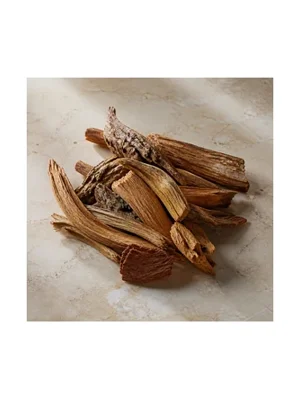
Sawn or milled wood of a true fir, genus Abies. No supplier sells a material under this name and no manufacturer publishes an olfactive description of fir timber. The only measurement found is Schreiner et al. (2020) in Analytical and Bioanalytical Chemistry, which quantified nine odour-active compounds across five softwoods, white fir (Abies concolor) among them, and reported hexanal, octanal, (E)-non-2-enal, p-cresol, vanillin and thymoquinone as the dominant wood odorants for the group. Any perfumery use of this note is a reconstruction, not a distillate.
Usage in Perfumery
Measured 2026-08-23 against the local Parfumo snapshot: 4 placements across 3 brands, and none on Fragrantica. Three of the four are base notes and one is a heart note, which is why the envelope is base rather than heart. Three of the four sit next to Cashmeran (Hugo Just Different in two concentrations, Kiton Ciro), so the note is being used as a clean modern wood rather than as a forest note. Use it where a soft pale wood is wanted with a vanillic edge. Use fir, fir-resin or canadian-fir-balsam instead when the green conifer lift is the point.
Similar Notes
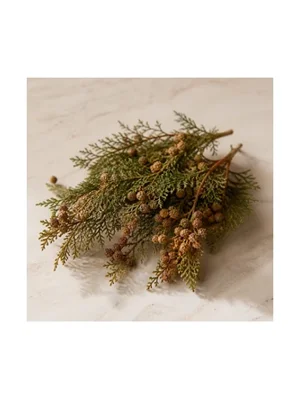
Perfumes featuring Fir Tree Wood
A selection of reviewed perfumes where Fir Tree Wood appears prominently.
No perfumes featuring this note have been reviewed yet. Check back soon.