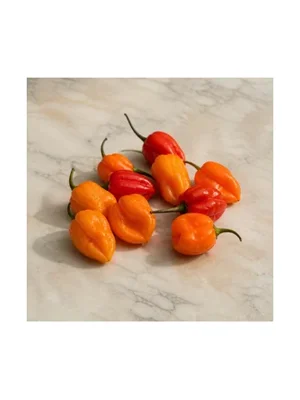
Habanero Chili
Note Profile
About
Habanero chili is the fruit of Capsicum chinense, and the sources that name it specifically lead with fruit, not heat. The Journal of Oleo Science calls it 'characterized by its strong pungency and fruity aroma'. Wikipedia pairs its heat with a 'floral aroma' and reports the Caribbean Red cultivar as 'citrusy and slightly smoky'. The fire is not part of the smell. Capsaicin is odourless, so the burn is trigeminal and reaches the nose only as an irritant edge, not as a spice note. That is why this vector is fruity-led where the published chili note is green-led.
Scent Profile
Fruity leads and it is the one thing every habanero-specific source says. The Journal of Oleo Science paper names it directly, 'strong pungency and fruity aroma', and the PMC compound work gives it a mechanism in the wider genus, 'sweet fruity aroma' from beta-ring citral, n-hexanol and 1-penten-3-ol. Green is real but held well under the published chili note's on purpose. The green evidence, 'green leaves, cucumbers, irritants, or herbs', comes from a paper that does not name Capsicum chinense at all, so it is general-pepper evidence used on a specific pepper. Citrus has two independent legs: the Caribbean Red cultivar is reported 'citrusy', and nonanal is given a 'citrus and orange-like odor'. Floral rests on Wikipedia's 'floral aroma' plus geranyl acetone's 'woody floral scent', two thin lines that agree, which is why its spread. Fresh_spice is the hardest number here and it is capped for a stated reason: capsaicin is odourless, so most of what people call habanero heat is not a smell. What is left is the PMC line 'a volatile irritating smell and a unique spicy flavor', an irritant carried by volatiles rather than by capsaicin, and is that residue and nothing more. Smoky is one cultivar only, 'slightly smoky' for Caribbean Red, so it stays a trace. Dry_woody is geranyl acetone's woody half. Sour and cooling_mentholic are zero although the published chili note scores both, because no habanero source mentions either, and their spreads are set at 0.10 to carry that gap rather than assert an absence.
ScentWheel
Read off the wheel, not a label applied to the note.
Origin
The ripe pod of Capsicum chinense, a species separate from the Capsicum annuum behind most published pepper notes. No fragrance house was found selling a discrete habanero aroma material. Every source here is horticultural or food-science work on the fruit itself, headspace GC-MS and sensory panels, not a perfumer's odour-description sheet. Two habanero-specific analytical papers were blocked: a Chemical Papers GC-olfactometry study of the Mayapan and Jaguar varieties behind a Cloudflare-class challenge, and a ScienceDirect ripening study behind an HTTP 403. Both would have given the ester-by-ester table this vector had to do without.
Usage in Perfumery
Attested 3 times on Parfumo across 2 brands, and absent from Fragrantica. The published chili note already carries three aliases, Bolivian Red Chili, Green Chili and Red Chili, so habanero was checked against it before scoring. It earns its own row: cosine to chili is 0.6972, well below the 0.90 bar, because the two are different species with different published analytical leads. Perfumers use it the way chili is used, as a small piquant accent, not as a body.
Similar Notes
Perfumes featuring Habanero Chili
A selection of reviewed perfumes where Habanero Chili appears prominently.
No perfumes featuring this note have been reviewed yet. Check back soon.