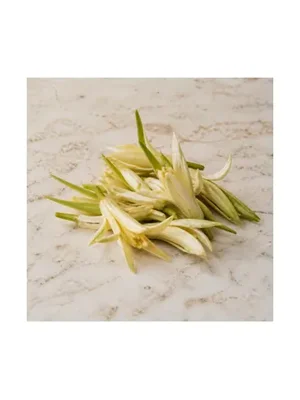
Kewra
Note Profile
About
Kewra is distilled from the male flowers of the screwpine, mainly in the Ganjam district of Odisha in eastern India. It is traditionally made as an attar in a sandalwood base. It smells sharp and diffusive at first, then sweet, honeyed and heady, with a green, hyacinth-like floral core. It is a signature of Indian attar perfumery.
Scent Profile
Sharp and penetrating at first, then sweet, honeyed and heady. The floral core is green and hyacinth-like, with a rosy, slightly fruity side and a faint waxy edge. In the attar, a soft sandalwood warmth sits underneath. It carries a white floral heart, with a hint of jasmine, under the hyacinth.
ScentWheel
Read off the wheel, not a label applied to the note.
ScentArt
Materials That Can Make This Note
Perfumers can build Kewra from materials such as:
-
Natural extract Kewda (kewra) flower oil, Pandanus odorifer / P. fascicularis
-
(2-methoxyethyl)benzene jasmine · rose · floral
Smell words come from published sources.
A given perfume with this note may use some of these, or something else.
Origin
Distilled from the male flowers of Pandanus odorifer (syn. P. odoratissimus), the screwpine, chiefly in Ganjam district, Odisha, in eastern India. The flower spikes are water-distilled in village copper stills. The attar catches the vapour in sandalwood oil. The pure oil is rooh kewra. Kewra water, the hydrosol, flavours Indian sweets and syrups. The main odorant is phenylethyl methyl ether, followed by terpinen-4-ol.
Usage in Perfumery
A signature note of Indian attar perfumery. The attar scents clothes, cosmetics, soaps, hair oils and incense sticks, and blends with most floral perfumes. It is very diffusive, so it is used at low doses. It is seldom used in Western fine fragrance.
Similar Notes
Perfumes featuring Kewra
A selection of reviewed perfumes where Kewra appears prominently.
No perfumes featuring this note have been reviewed yet. Check back soon.