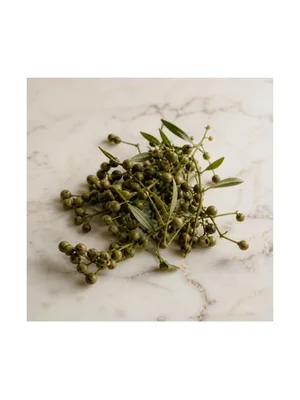
Linaloe Berry
Note Profile
About
Linaloe berry is the oil steam-distilled from the ripe fruit of the Mexican linaloe tree, not from its wood. It smells of a soft creamy wood with a lavender-like freshness over it and a light citrus lift. Trade sources sell it as a stand-in for rosewood, which is restricted, and place it beside lavender and bergamot mint. Only two retail sources describe the smell, so this vector is held loosely and the spreads are wide.
Scent Profile
Creamy_woody leads on the source's own two words, 'creamy' and 'woodiness', and because linalyl acetate over a Bursera wood body reads soft rather than dry. Aromatic_herbal carries the lavender and bergamot mint comparison, which is a chemical fact as much as a trade one: the same ester defines all three oils. Floral is the 'woody-floral effect' the rosewood comparison rests on, scored below the wood because both sources put the wood first. Citrus is the 'slightly citrus-tinged' lift, named once and qualified as slight. Dry_woody is the harder edge of the same wood, held low because nothing in the sources calls it dry or resinous, and its Bursera relatives palo santo and copal are not the comparison anybody reached for. No green facet is scored. Nobody described one, and inventing it to separate this from rosewood would be asserting an absence in reverse.
ScentWheel
Read off the wheel, not a label applied to the note.
Origin
Bursera delpechiana, Burseraceae, the Mexican linaloe tree. Acta Botanica Mexicana 91 (2010) reports that DNA sequences of the Indian B. delpechiana 'were all identical to those of B. linanoe', so the Indian plantations and the Mexican wild trees are one species. Indian producers moved to 'distilling the mature fruits instead of the wood, as it had been done in Mexico', and that split the trade into a berry grade and a wood grade of the same tree. The dominant natural constituent is linalyl acetate, not linalool: the paper states that 'linalyl acetate is known to change into linalool by thermal hydrolysis during steam distillation', so the linalool in older analyses is made by the still. The tree is also sold as Indian Lavender and Tree of Fragrance, which are marketing names for this species and not for Lavandula.
Usage in Perfumery
A linalool-type freshener for the heart, used where rosewood once was. Premiere Peau frames it as the substitute: 'Unlike rosewood oil (now severely restricted due to deforestation of Aniba rosaeodora), linaloe berry provides a comparable linalool-rich woody-floral effect from a less endangered source.' Nature In Bottle names lavender and bergamot mint as blending partners. Attested on 5 Fragrantica entries and absent from Parfumo. Fragrantica files it under Greens, herbs and fougeres.
Similar Notes
Perfumes featuring Linaloe Berry
A selection of reviewed perfumes where Linaloe Berry appears prominently.
No perfumes featuring this note have been reviewed yet. Check back soon.