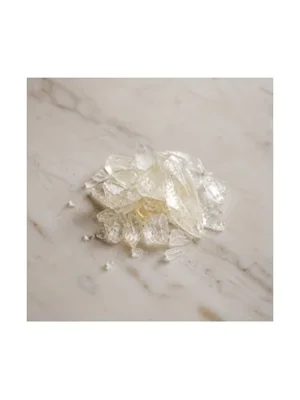
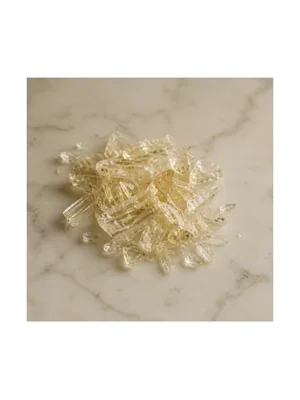
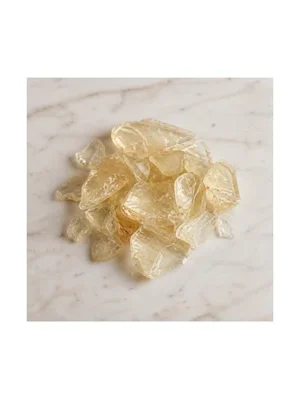
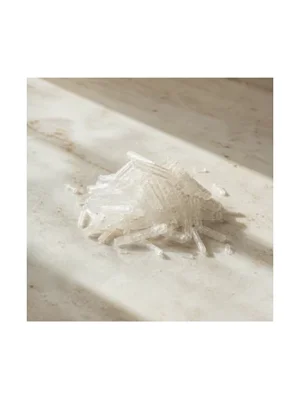
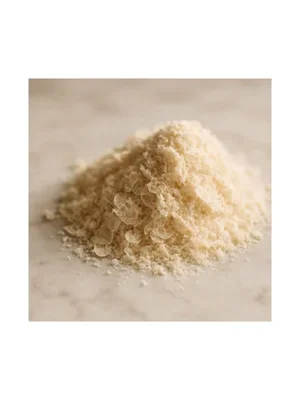
A synthetic nitro musk. It smells sweet, warm and strongly powdery, with a soft animal warmth under it and a faint floral-fruity lift. It is very tenacious and was used as much for fixing a formula as for its own smell. EU regulation now classes it CMR Category 2 and it has largely been replaced by macrocyclic and polycyclic musks.
Scent Profile
Clean_musk is the note, and all four sources agree on it. Scentspiracy gives the primary character as 'soft, clean musk with pronounced powdery qualities'. Powdery sits just under it and is the second thing every source says: COSMILE Europe reads the odour as 'musk-like, powdery animal', and Scentspiracy separately calls the drydown 'cleaner and more powdery' than the other historic nitro musk. Two independent publishers naming the same facet is why powdery is this high and its spread this narrow. Sweet_vanillic comes from 'warm, sweet-powdery' and from The Perfumer's Apprentice, whose whole description is 'sweet and very tenacious musky odor'. It is a sweetness claim without a vanilla claim, so it is held below the powder. Animalic is the honest low end of a real disagreement: Scentspiracy files it twice as 'subtle animalic undertones' and 'softly animalic', while COSMILE writes 'powdery animal odour' with no hedge. Subtle wins because two of the four sources qualify it and none call it dominant. Amber_resinous, floral and fruity are all from the one source that lists them, and it marks each as a trace: 'discrete floral-fruity nuances' and 'slightly ambery, warm aromatic aspects'. Dry_woody is not stated by anyone and is held at a token value with a wide spread rather than zeroed, because no source asserts its absence either.
Read off the wheel, not a label applied to the note.
What this is made of
musk ketone
Names this molecule
CAS 81-14-1
The note IS the molecule. Its origin states CAS 81-14-1 and the full name 4-tert-butyl-2,6-dimethyl-3,5-dinitroacetophenone, which is this row.
Specification
An IFRA Standard limits how much of this a perfumer can usethe limit applies to the perfumer, not the wearer
These are facts about the substance, not about any perfume with this note.
Why that matters
A perfume that names Musk Ketone can use a different extract, a
reformulated version, or a synthetic reconstruction. It can also hold less
than the amount that requires a declaration. We cannot tell which applies.
These rows cover only the substances we hold a link for.
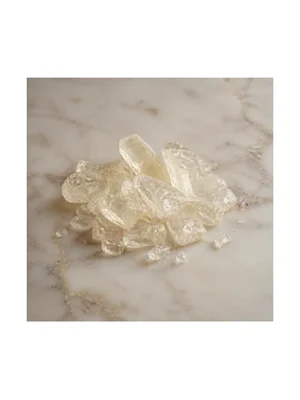
Made synthetically. 4-tert-butyl-2,6-dimethyl-3,5-dinitroacetophenone, CAS 81-14-1. The American Chemical Society records that Albert Baur made it in 1888 by accident, while looking for a better route to TNT. COSMILE Europe describes the material as a yellowish solid, practically insoluble in water. It has no natural source at all.
Usage in Perfumery
Attested on 4 Parfumo note listings across 2 brands, and absent from the Fragrantica note vocabulary. The ACS calls it a fixative in perfumery, because it slows the loss of the more volatile parts of a formula and lengthens the whole. It was a structural part of several twentieth-century classics. Its EU CMR Category 2 classification is why current usage is small.
A selection of reviewed perfumes where Musk Ketone appears prominently.
No perfumes featuring this note have been reviewed yet. Check back soon.
We use cookies to improve your experience and understand how you use our site.
Read our cookie policy
Cookie Preferences
Choose which cookies you'd like to accept. Essential cookies cannot be disabled
as they're required for the website to function.
Always On
Required for the website to function. Includes session management and security tokens.
Help us understand how visitors use the site. We use Umami (privacy-focused,
cookieless) and Google Analytics to measure usage without tracking you across websites.