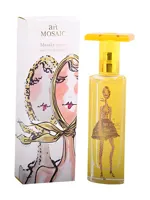
Art Mosaic
EDP · 2012
Masaki Matsushima
Favourite
Note Profile
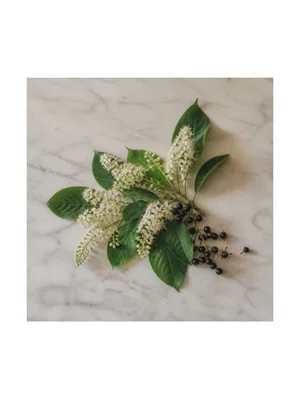
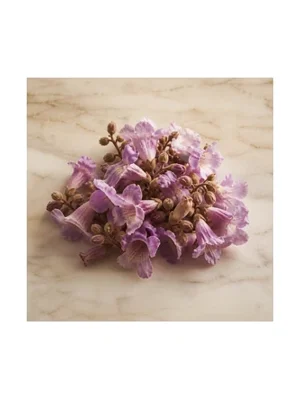
Paulownia tomentosa, the princess or empress tree, carries panicles of lilac trumpet flowers in spring. The note is the flower, not the wood. It smells of vanilla first. The vanilla is powdery and almond-edged rather than a food sweetness, and it sits on a heavy white-floral body that a trade source compares to hyacinth and tuberose.
Princess Tree flowers smell of vanilla first, powdery and almond-edged rather than food-sweet. Underneath sits a heavy white floral body, buttery and tuberose-like, close to hyacinth. A fruity quality lifts the whole thing, with a soft, buttery lactonic texture running through the bouquet.
Read off the wheel, not a label applied to the note.
Tap a perfume to see where Princess Tree (Paulownia) sits in it. The rest of the picture goes grey
Paulownia tomentosa, native to central and western China and naturalised across the eastern United States, where it is treated as invasive. The flowers are not extracted at commercial scale. The one trade offering found is a 5 ml enfleurage maceration sold as extremely rare. Roman Kaiser's headspace work, quoted second-hand through the Glass Petal Smoke blog, attributes the character to hydroquinone dimethyl ether interacting with beta-ionone and its derivatives and with methyl cinnamate, and calls the result 'a heliotropin related note'. That is why the vanilla reads powdery: it is generated by the interaction, not by a vanillin or a heliotropin actually dominating the headspace.
Attested 3 times on Fragrantica and not at all on Parfumo. Fragrantica files it under Flowers. Because there is no commercial extract, any use is a reconstruction.
A selection of reviewed perfumes where Princess Tree (Paulownia) appears prominently.
New finds, honest verdicts, and price drops.
No spam. Unsubscribe anytime. See our privacy policy.