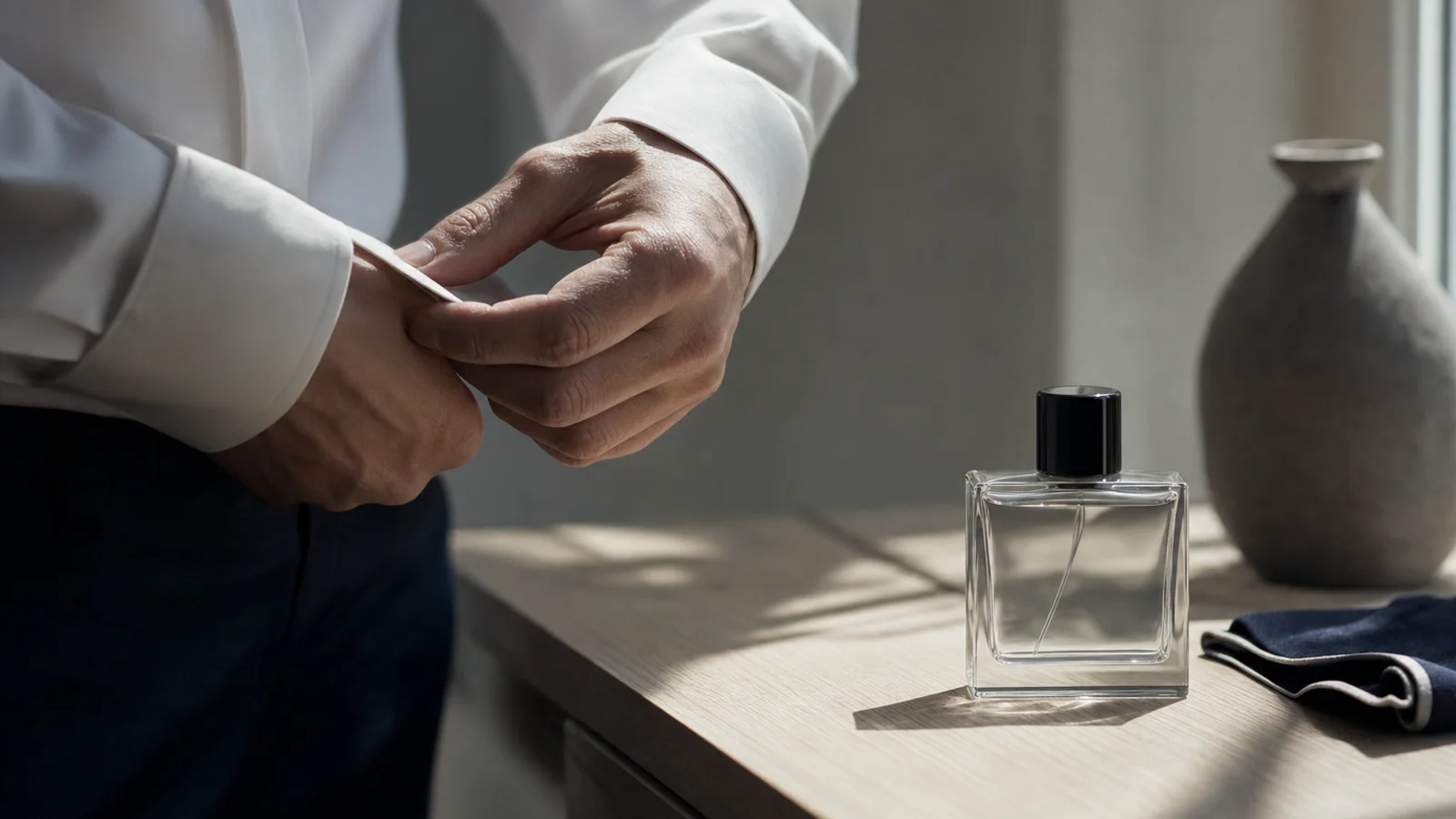
Ask for aftershave in a British shop and you will be handed a bottle of men's fragrance. Look the word up and you get something else. The Cambridge Dictionary defines aftershave as "a liquid with a pleasant smell that a man puts on his face after shaving". That is a skincare product, and a different thing from a scent you wear for the day.
Both meanings are in everyday use, and most of the confusion about aftershave comes from one person using the first while the other hears the second.
Aftershave, the shaving product
In the strict sense, aftershave is what you put on your face straight after a razor has been over it, and it comes as either a splash or a balm.
A splash or lotion is the traditional one: a thin liquid built on alcohol or witch hazel, which works as an antiseptic on skin that has just been scraped. It stings for a moment, which is the alcohol doing its work, and barbers have used it that way for generations.
A balm is the gentler modern alternative. It is creamier and usually carries far less alcohol, so it calms and moisturises rather than disinfects. People with dry or sensitive skin tend to prefer it.
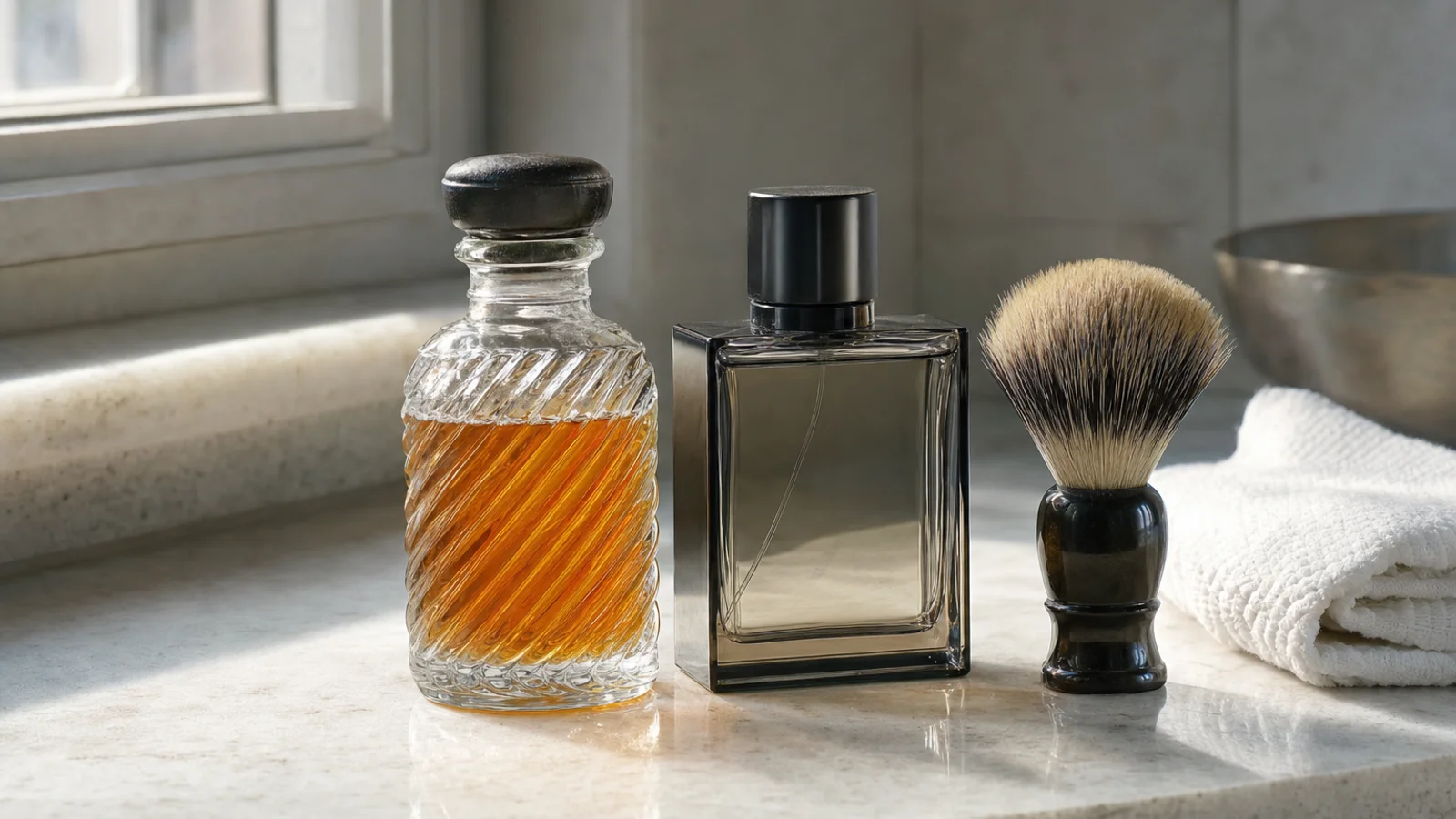
Both usually carry a scent, but the scent rides along. It makes the product pleasant to use and fades quickly on skin. Heritage barbershop houses have long sold an aftershave and a matching cologne side by side for exactly that reason: the aftershave looks after the skin, and the cologne does the smelling.
What does aftershave do?
It soothes skin that is irritated after a shave, which is where razor burn and redness come from. The alcohol in a splash disinfects the tiny nicks a blade leaves behind, even the ones you cannot see, and a balm puts back the moisture that shaving strips out.
It is no substitute for a fragrance. A splash put on at seven in the morning will not leave you smelling of anything at five in the afternoon.
Aftershave, the everyday word for men's fragrance
In everyday British English, "aftershave" has become the general word for a man's fragrance, much as Americans say "cologne". Boots files its men's bottles under "Men's Aftershave", and its own navigation runs "perfumes & aftershaves", with perfume for women and aftershave for men. Someone who asks for aftershave for Christmas usually means an eau de toilette or eau de parfum in a box, not a bottle of post-shave splash.
Used this way, the word tells you nothing about strength. An "aftershave" in this sense is whatever concentration is printed on the box, and that is the thing to check. Our guide to eau de parfum and eau de toilette explains the ladder from the lightest cologne up to parfum, and what each rung means for how long a scent lasts.
If this is the aftershave you are shopping for, our round-up of the best aftershave for men ranks thirteen of them, from everyday bottles to the ones worth saving for. Its list of dependable everyday picks opens with Bleu de Chanel by Chanel.
Is aftershave the same as cologne or perfume?
That depends on which aftershave you mean.
The shaving product is not the same as either. It is skincare that happens to smell nice. A true Eau de Cologne, the lightest fragrance concentration, is made to be worn for its scent, and a perfume more so.
The everyday UK aftershave is the same kind of thing as cologne and perfume: a fragrance. The word "aftershave" is doing the job that "cologne" does in American English, and "perfume" is what the same bottle would often be called if it were sold to a woman. Our piece on cologne versus perfume untangles those words properly, including why "cologne" means one thing in a British shop and another in an American one.
Can you wear aftershave as cologne?
If you mean the shaving product, you can. Nothing about a splash stops you putting it on your neck and wrists. It will smell fine and then disappear, because lasting was never its job. People who like the smell of their aftershave often buy the matching eau de toilette for that reason.
It works the other way round too, with a caution. Spraying an eau de toilette or eau de parfum straight onto a freshly shaved face will sting, because of the alcohol, and it does nothing for the skin. If you want both, use a splash or balm on your face and spray the fragrance on your neck or chest.
Does aftershave go off?
Yes, slowly, for the same reasons perfume does. Air, light and heat work on the fragrance oils over time, and the brightest top notes fade first. An old bottle usually gives itself away with a sharper or slightly sour opening, or a colour darker than it started. Nothing about it turns dangerous; it just stops smelling like the thing you bought.
The advice is the same as for perfume: keep the cap on, keep the bottle upright, and keep it somewhere cool and dark rather than on a sunny shelf. Our guide to whether perfume expires covers the signs and the storage in detail, and all of it applies to aftershave.
Which one you need
For your skin after shaving, you need the shaving product: a splash if you like the ritual and the sting, a balm if your skin is dry or easily irritated.
If it is what you smell of that matters, you need a fragrance, whatever the shop calls it. Check the concentration on the box, because that tells you far more than the word on the shelf.