If you landed here looking for the oud, the stringed instrument played across Arabic and Turkish classical music, that is a different oud entirely - the two just share an Arabic word. This guide is about oud the fragrance ingredient: what it actually is, why the smell divides people so sharply, why it costs what it does, and where to try it at every price point from supermarket to luxury.
Oud in brief
| Question | Answer |
|---|---|
| What is oud | Resinous heartwood formed inside Aquilaria trees after a fungal infection, also called agarwood or agar |
| What does it smell like | Varies hugely - real Hindi-style oud is animalic and medicinal, most Western "oud" fragrances are clean, sweet and woody |
| Why is it expensive | Wild agarwood is rare (only a small minority of trees ever form it), CITES-protected, and slow to harvest |
| Is the oud in my perfume real | Usually not - most high-street "oud" scents use a synthetic reconstruction |
| Is oud only for Arabian perfumery | No, but Arabian perfumery treats it as the main event; Western perfumery uses it as a supporting note |
What oud actually is
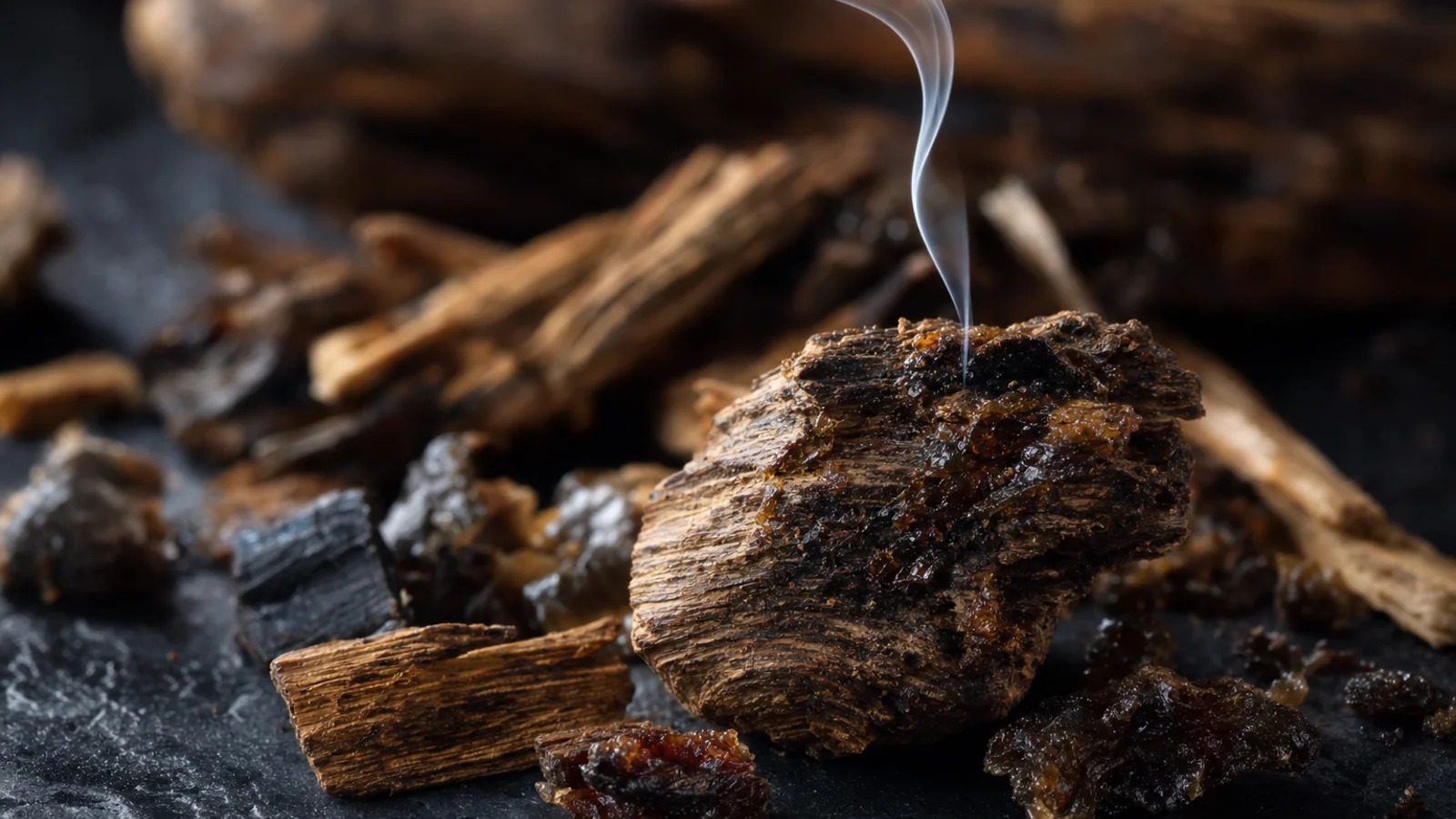
Oud, the fragrance material, is resinous heartwood that forms inside Aquilaria trees after they are wounded and infected by a parasitic mould, commonly Fusarium or Phaeoacremonium. A healthy Aquilaria tree is pale, soft and odourless. Infected, it floods the wound with a dark, fragrant resin, and that resin-soaked heartwood is what gets carved out, distilled or burned as incense.
The same material goes by several names: agarwood in English, oudh or aoud in the Gulf, agar in South Asia. Oud, oudh and agarwood are the same thing, not three ingredients.
This explains the price tag before we even reach CITES: only a small minority of wild Aquilaria trees ever form usable agarwood, and it can take decades. The cost, the plantation industry and the synthetic substitutes all follow from that scarcity.
What oud actually smells like
This is where most confusion starts. Oud has no single smell; two fragrances both marketed as "oud" can smell like they have nothing in common.
Real, high-grade agarwood, the kind most associated with Indian oud, is barnyard-funky, leathery, medicinal and often faintly animalic, closer to a hospital dressing or a wet forest floor than anything conventionally pretty. It divides opinion hard, even among enthusiasts. If a perfume marketed as "oud" has struck you as clean, sweet and inoffensively woody, you were not smelling anything close to this.
What you were probably smelling is the Western designer version: a soft, sweet-woody oud accord built to be pleasant rather than authentic, usually with rose, saffron, amber or vanilla doing most of the work. It bears roughly the relationship to real Hindi oud that a candle labelled "rain" bears to an actual thunderstorm. Neither is "the fake one" exactly; they answer different questions.
Geography adds another layer. Our own note tags separate Cambodian oud from Indonesian oud and other regional grades, since wild agarwood smells different by forest and fungal strain. Modern budget ouds increasingly lean into a bright, almost fruity oud facet with little to do with either camp above.
Why oud is so expensive, and why most of it probably isn't real
Three things push genuine oud's price above almost any other perfume ingredient. It is rare, for the reason above: most wild trees never form it at all. It is slow: an Aquilaria tree needs decades to build meaningful resin, and even artificially inoculated plantations, now the main legal source, take years per tree. And it is regulated: Aquilaria malaccensis was listed under CITES Appendix II in 1995, and every Aquilaria species has been covered since January 2005. A kilo of genuine oud oil can run into five figures.
The useful thing to know before buying anything marketed as "oud": most of it, below the true luxury tier, leans heavily on a synthetic oud accord rather than real agarwood, built in a lab to hit the same broad notes, woody, ambery, faintly smoky. That is standard practice at lower price points, not a scandal. Some of these accords blend in a small natural fraction; without formula disclosure, there is no way to know the proportion. Fragrances built on natural oud or a genuine oud absolute tend to say so plainly, because it is their whole selling point.
Arabian oud vs Western oud
Treat these as two separate traditions, not one ingredient used two ways.
In Gulf perfumery, oud is the main event, not a supporting note. It is often worn as a concentrated oil or attar, or burned as bakhoor incense, while alcohol-based compositions run from eau de parfum up to extrait strength, stacked with rose, saffron, amber and heavy musks for something intense and identifiable across a room. Richer blends sometimes mix multiple ouds from different origins deliberately, like a whisky blender mixing casks.
Western designer perfumery mostly treats oud as a flavour, not a genre: folded into an eau de parfum alongside a dozen other notes, softened and diluted until it reads as "a bit woody and exotic" rather than agarwood in any recognisable sense. A legitimate choice, built for a different idea of what a daily-wear fragrance should do. Knowing which tradition a bottle draws from saves disappointment either way.
Where to start
Every pick below is from our own catalogue, not marketing copy, and spans the real range: cheap entry points, a designer-into-niche crossover, and the names that define the category.
1. Marks & Spencer Smoked Oud - a cheap, approachable way in
Marks & Spencer Smoked Oud (EDT, masculine, budget). Our verdict: "an affordable yet sophisticated oud fragrance that offers impressive longevity and a warm, woody scent profile, making it a versatile addition to any collection."
2. Maison Alhambra Your Touch Oud - the sleeper
Maison Alhambra Your Touch Oud (EDP, masculine, budget). Our verdict calls it "a proper dark horse... for its bargain basement price, it delivers a genuinely seductive, luxurious oud-vanilla experience that smells far more expensive than it is." Give it time to macerate after buying.
3. Lattafa Oud for Glory - the Arabian-register powerhouse
Lattafa Oud for Glory (EDP, unisex, budget) is, in our own words, "huge, regal oud with a syrupy amber-vanilla warmth... a beastly, crowd-commanding powerhouse. Not for the shy or the office." Sample first; it is loud by design.
4. Parfums de Marly Layton Exclusif - the animalic upgrade
Parfums de Marly Layton Exclusif (EDP, unisex, mid-range) pushes the brand's popular Layton into "a sumptuous, animalic oud-vanilla powerhouse. Deeply opulent, brooding, and unapologetically rich." A step from designer territory towards niche.
5. Tom Ford Oud Wood - the reference point
Tom Ford Oud Wood (EDP, unisex, luxury) is one of the most-copied designer ouds around, as our own catalogue of dupes shows. Our verdict: "a modern icon that balances exotic oud with creamy woods and warm spice... sophistication without brashness."
6. Louis Vuitton Ombre Nomade - the smoke bomb
Louis Vuitton Ombre Nomade (EDP, unisex, luxury) leans into the real-agarwood register above: "a brooding, ultra-rich oud-rose powerhouse that floods the room with smoky, leathery opulence. Not for the faint of heart or casual wear."
7. Guerlain Oud Essentiel - the polished middle ground
Guerlain Les Absolus d'Orient Oud Essentiel (EDP, unisex, luxury) is, by our own verdict, "Western-tailored Arabian oud done right, with bone-dry agarwood, smoky olibanum and a leather-rose backbone... the polished niche oud Western buyers reach for" - the bridge between the two traditions above.
How to wear oud
Oud is potent by nature, so "more is more" works against you. Start cautiously with the stronger picks above and adjust to the specific fragrance; concentration and formula vary too much across this list for one spray count to hold for all of them. Cooler weather suits oud better than summer heat, which pushes the smoky, resinous facets toward overwhelming. New to the family? Start with a lighter EDT pick and live with it a day before judging it.
Common questions
What is an oud perfume?
Strictly, a fragrance built around agarwood. In practice, it means any fragrance marketed with oud in the name or as a headline note - real agarwood oil (rare), or a synthetic reconstruction built to smell similar (common).
What does oud smell like?
It depends which oud. Real, high-grade agarwood leans barnyard, medicinal, leathery and animalic. Most Western designer "oud" fragrances smell clean, sweet and woody, closer to sandalwood with the volume up. Both are legitimately called oud; they answer different questions about what an oud fragrance should do.
What does "oud" mean?
Oud, also spelled oudh or aoud, is Arabic for "wood." In perfumery it means agarwood. The same word also names an unrelated stringed instrument central to Arabic and Turkish music; the two share an origin word, not a subject.
Is buying oud illegal?
No, but wild agarwood is regulated. Aquilaria malaccensis was listed under CITES Appendix II in 1995, and every Aquilaria species has been covered since January 2005, controlling cross-border trade rather than banning it outright. Synthetics fall outside CITES entirely, and finished retail perfumes are generally exempt; it is raw plantation-grown agarwood that stays regulated.
How we put this together
We drew the Aquilaria and CITES background here from published fragrance-industry and conservation sources, not manufacturer copy. The picks reflect our own published verdicts, compiled from community reviews. For related reading, see our guides to what is a fougere and what is an elixir perfume.