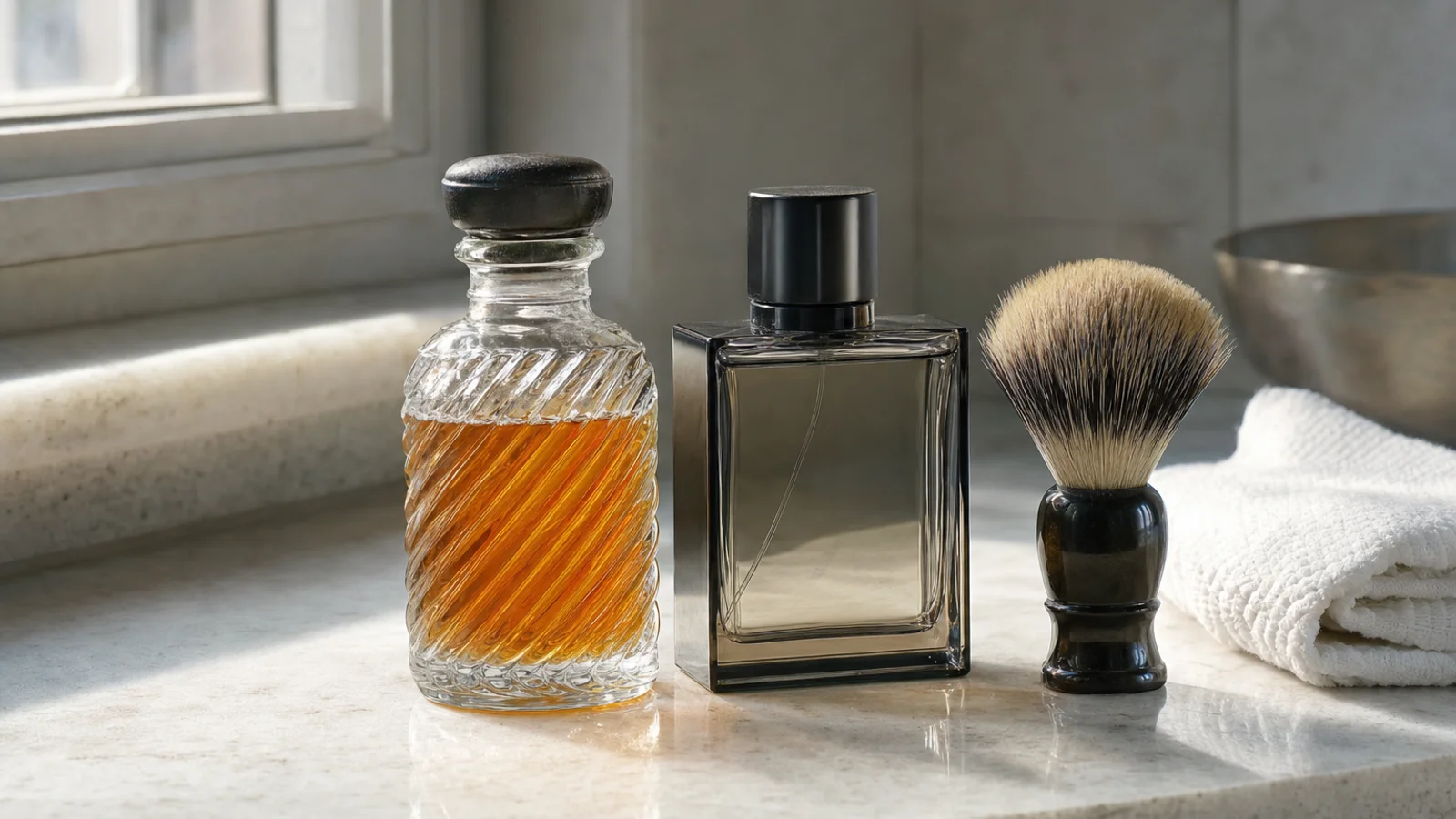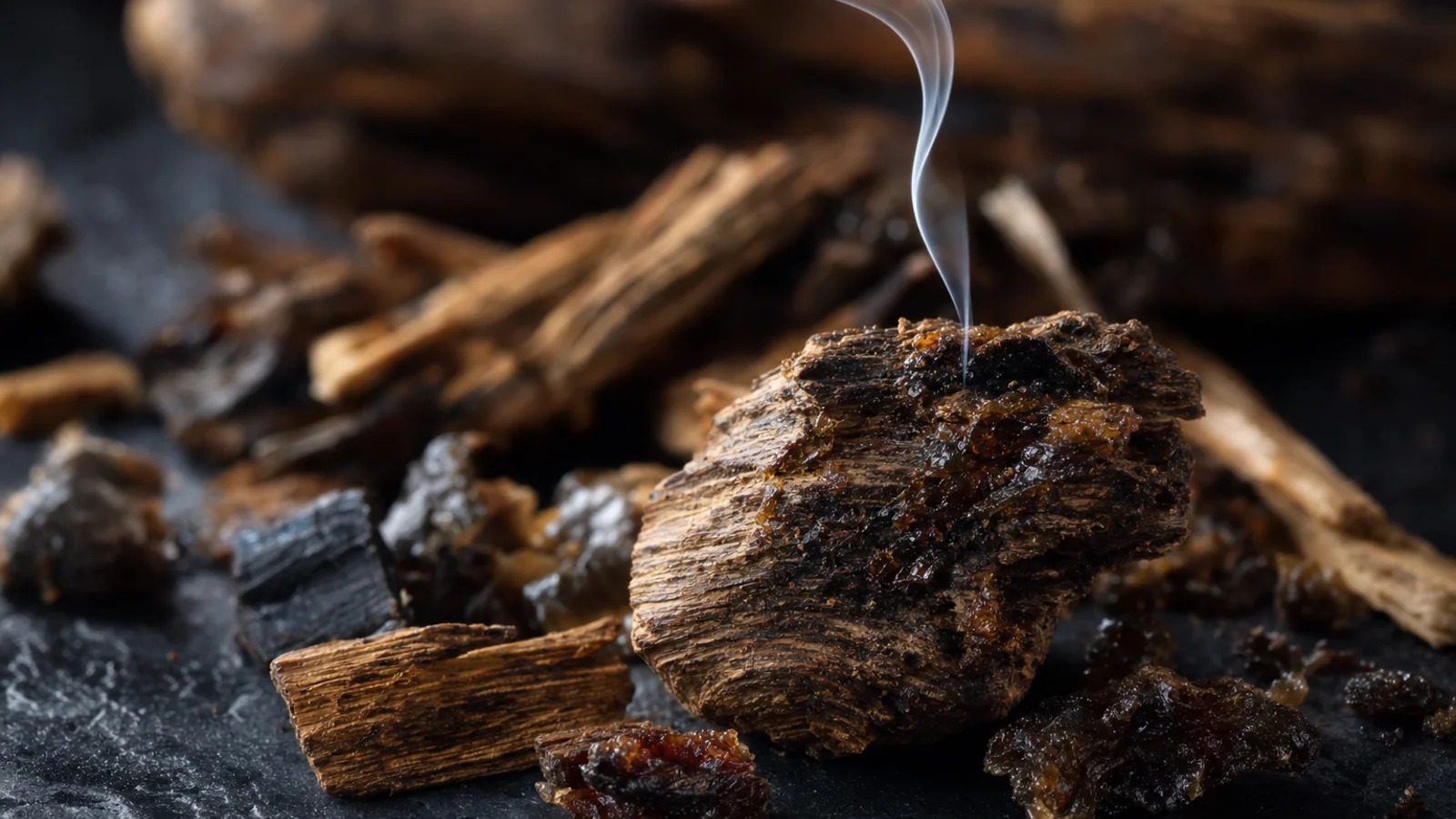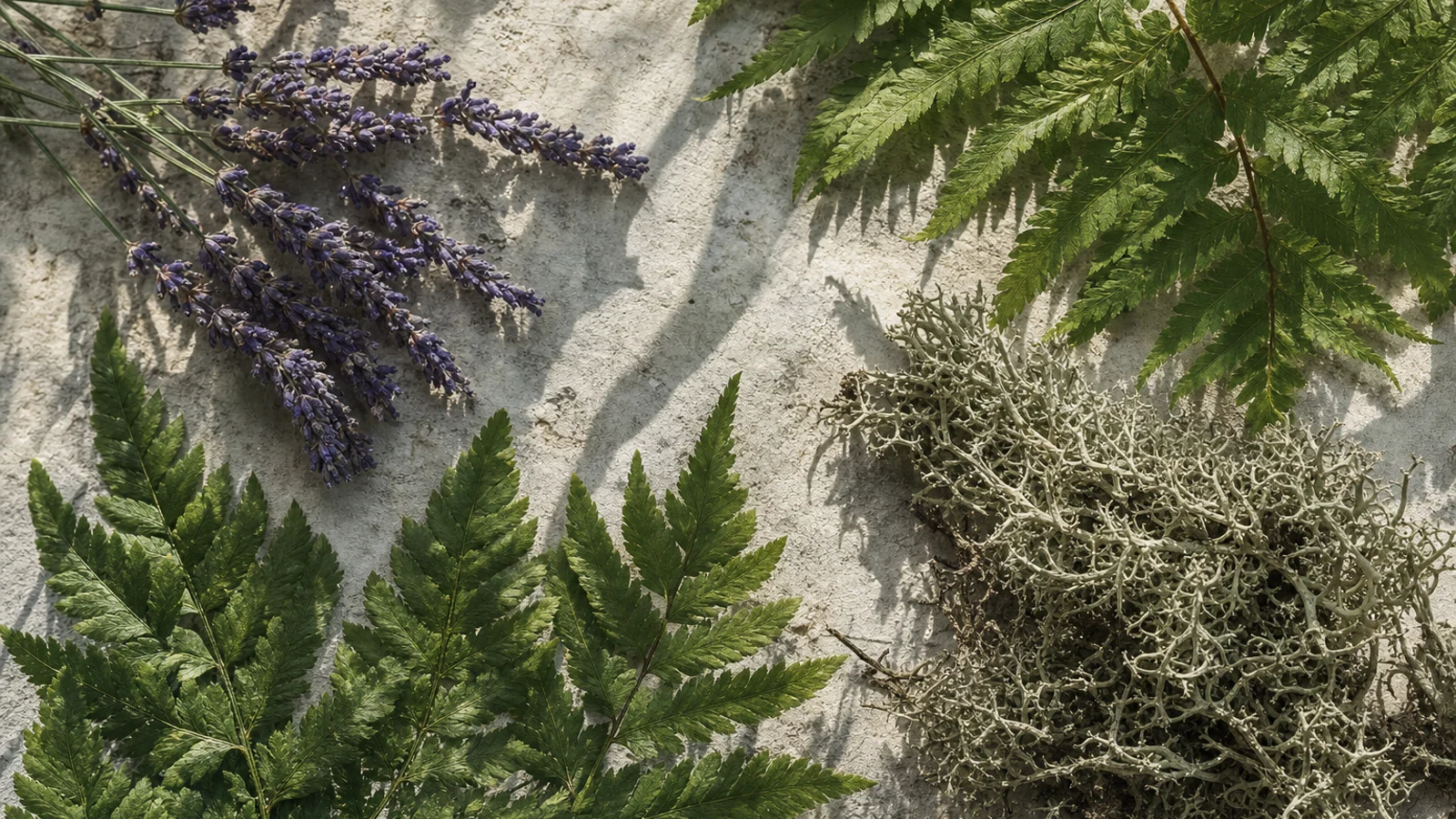
A fougere is a fragrance accord, not an ingredient: lavender over oakmoss over coumarin, with citrus and woody support around the edges. The name comes from the French word for fern, and that name is the joke at the centre of the whole family, because ferns have almost no smell of their own. The fougere accord was invented anyway, in 1882, by a perfumer imagining what a fern ought to smell like if it had a scent worth bottling. It went on to become the single most-used structure in men's perfumery, which is why a huge share of the aftershaves and "clean masculine" fragrances on any shelf smell distantly related to each other, whether they were made in 1978 or last year.
Fougere in brief
| Question | Answer |
|---|---|
| What is a fougere | An accord built from lavender, oakmoss and coumarin, not one ingredient or note |
| Who invented it | Paul Parquet, for Houbigant, in 1882 |
| What does it smell like | Herbaceous and sharp on top, then a mossy, hay-like, slightly sweet base |
| Is it only for men | No, but it has been marketed almost exclusively at men since the 1880s |
| Where to try the original today | Fougere Royale Extrait de Parfum, Houbigant's 2010 rebuild of the 1882 idea |
The perfume that started it, and the fern that never smelled of anything
In 1882, Houbigant's in-house perfumer Paul Parquet built a fragrance called Fougere Royale around a material that had never been used in perfumery before: coumarin, first isolated in workable form from the tonka bean. Coumarin smells of fresh-cut hay and marzipan-sweet almond, nothing like a fern, and that was rather the point. Ferns are one of the few widely-loved plants with almost no scent of their own, so naming a perfume after one meant Parquet wasn't imitating nature, he was inventing an idea of nature that didn't exist before he built it. He paired that coumarin with lavender and oakmoss and created a completely new fragrance family in the process, one that eventually led to Brut, Azzaro, Drakkar Noir, Fahrenheit and hundreds of others carrying the same bones.
The original Fougere Royale disappeared from sale by the late 1960s. Houbigant relaunched the name in 2010 as an Extrait de Parfum composed by Rodrigo Flores-Roux. It isn't the 1882 formula rebuilt exactly, since several of the original raw materials are long since restricted or reformulated, but our own verdict calls it "the OG fougere, reimagined for the modern gent," and it's the closest thing on general sale to smelling the idea Parquet had.
The three notes that define every fougere
Every fougere runs on the same three-note skeleton, whatever branch it belongs to:
- Lavender, usually up top, giving the clean, herbaceous opening most people associate with "barbershop" or "aftershave"
- Oakmoss, at the base, a mossy, earthy, faintly leathery note that reads as the smell of a damp forest floor
- Coumarin, also at the base, adding a warm, sweet, hay-like undertone, usually alongside actual tonka bean, which contains coumarin naturally
Bergamot and geranium are the two notes that turn up in almost every fougere built since 1882, bridging the sharp citrus top and the herbaceous heart. Once you know to listen for that lavender-oakmoss-coumarin frame, you can hear it repeating across nearly a century and a half of releases.
Three branches, and the catalogue examples that prove each one
Aromatic fougere is the original branch, and the one most people picture when they hear the word: lavender-forward, herbal, unmistakably barbershop. Azzaro pour Homme (1978, by Gerard Anthony for Azzaro) is still sold and still wears as a textbook example, and our own verdict calls it "the definitive old-school men's fragrance." Drakkar Noir from Guy Laroche, composed by Pierre Wargnye, pushed the same structure sharper and colder with a synthetic freshening agent that hadn't been used in fine fragrance before it, which is why it still smells more modern than fragrances a decade older than it.
Fresh and aquatic fougere is the branch that redefined men's fragrance through the late 1980s and 1990s. Cool Water from Davidoff (1988, Pierre Bourdon) kept the lavender and oakmoss but added a sea-water, mint-forward opening that turned the fougere from a barbershop scent into a beach-and-office staple. It is also one of the cheapest genuine entry points into the family in our catalogue.
Amber and oriental fougere pushes the base warmer and sweeter instead of mossier. Le Male from Jean Paul Gaultier (1995, Francis Kurkdjian) keeps the lavender opening but swaps the mossy base for vanilla, tonka and amber, and our page calls it "an icon for its creamy lavender-vanilla blend." Eros from Versace (2012, Aurelien Guichard) does the same trick with a fruitier top and a heavier amber base, and at over three decades younger than Le Male, it is proof the branch hasn't stopped moving.
Why an old bottle can smell different from a new one
If you have ever compared a vintage fougere to the current formula of the same fragrance and found the new version thinner or sweeter, that isn't your nose playing tricks. Oakmoss naturally contains two compounds, atranol and chloroatranol, identified as skin allergens, and the industry body IFRA progressively restricted them from the early 2000s, with the EU banning non-compliant products outright by 2019. Houses responded by switching to treated oakmoss with the allergens stripped out, or to synthetic substitutes that approximate the smell without quite the same depth. The mossy, damp-forest base that defined fougere for a century is the part that has taken the biggest hit, and it's one reason the newer amber and aquatic branches lean on tonka and ambroxan instead of oakmoss: they sidestep the restriction rather than fight it.
Where to start smelling them
Do not go looking for a single "pure" fougere; the family has been mutating since 1882 and every branch above is a legitimate answer. Pick a branch that matches how you actually want to smell. Cool Water is the cheapest honest way into the fresh, aquatic side. Azzaro pour Homme is the classic barbershop version at a mid-range price. Le Male is the sweeter amber take, and the one most likely to read as a compliment-getter rather than a throwback. If you want to smell where the whole thing started, Fougere Royale is the only widely available bottle still carrying the original 1882 name, even though the original formula itself is gone for good. And if fougere turns out to be your family, our guide to what is a masculine fragrance covers the wider territory it sits inside.
Common questions
Is fougere only for men?
No, but it has been marketed almost exclusively at men since the 1880s, so the wider culture treats it as a masculine signature. Nothing about lavender, oakmoss or coumarin is inherently gendered; a handful of niche and unisex houses use the same structure without marketing it by gender at all.
What does fougere actually smell like?
Herbaceous and slightly sharp on top from the lavender, then a warm, mossy, faintly sweet base from the oakmoss and coumarin together. Community reviews on our own perfume pages describe it most often as "clean," "barbershop" or "soapy," which is the fougere structure doing exactly what it was built to do.
Is Fougere Royale still available to buy?
Yes, but not in its 1882 form. Houbigant's 2010 relaunch, sold as Fougere Royale Extrait de Parfum, is a modern reading of the same idea rather than a restoration of the original formula, which relied on raw materials no longer permitted at the same strength.
What is the difference between fougere and chypre?
Both use oakmoss as a base note, which is why the two get confused. Chypre pairs that oakmoss with bergamot and labdanum for a drier, more austere result. Fougere pairs it with lavender and coumarin for a softer, sweeter, more herbaceous one. Fougere has leaned masculine-coded in marketing and chypre has historically leaned feminine-coded, though both conventions are looser than they used to be.
How we put this together
This explainer draws on the accord and note data we hold across our catalogue, plus the concentration, longevity and verdict data on each linked perfume page. The historical detail on Fougere Royale, Paul Parquet and the 1882 launch, and the IFRA oakmoss restriction timeline, are drawn from published fragrance history and industry regulatory sources rather than manufacturer copy. For more on how individual raw materials change a fragrance, see Perfume Notes Explained and Understanding Accords. For the wider category this family sits inside, see our guide to what is a masculine fragrance.