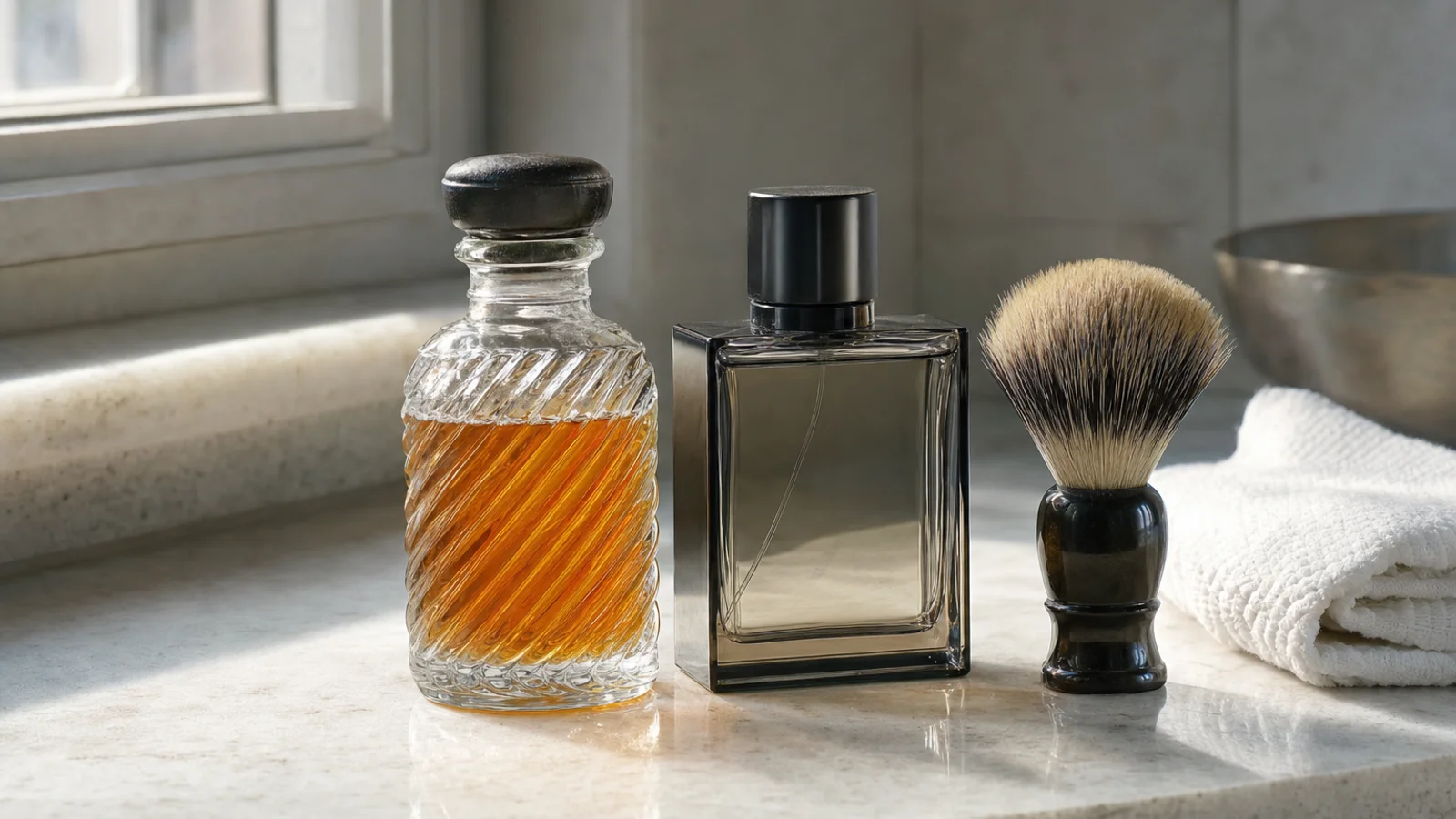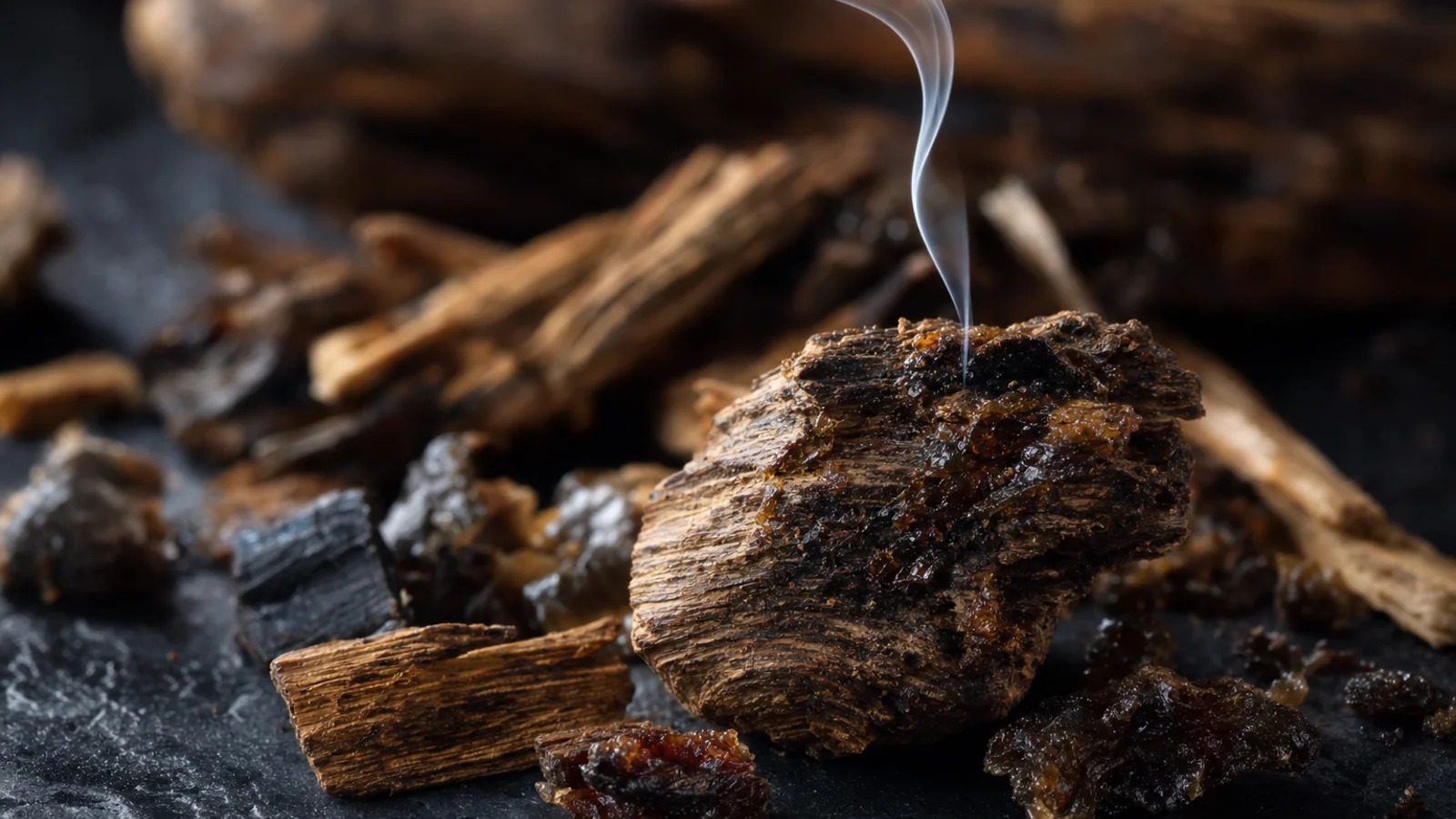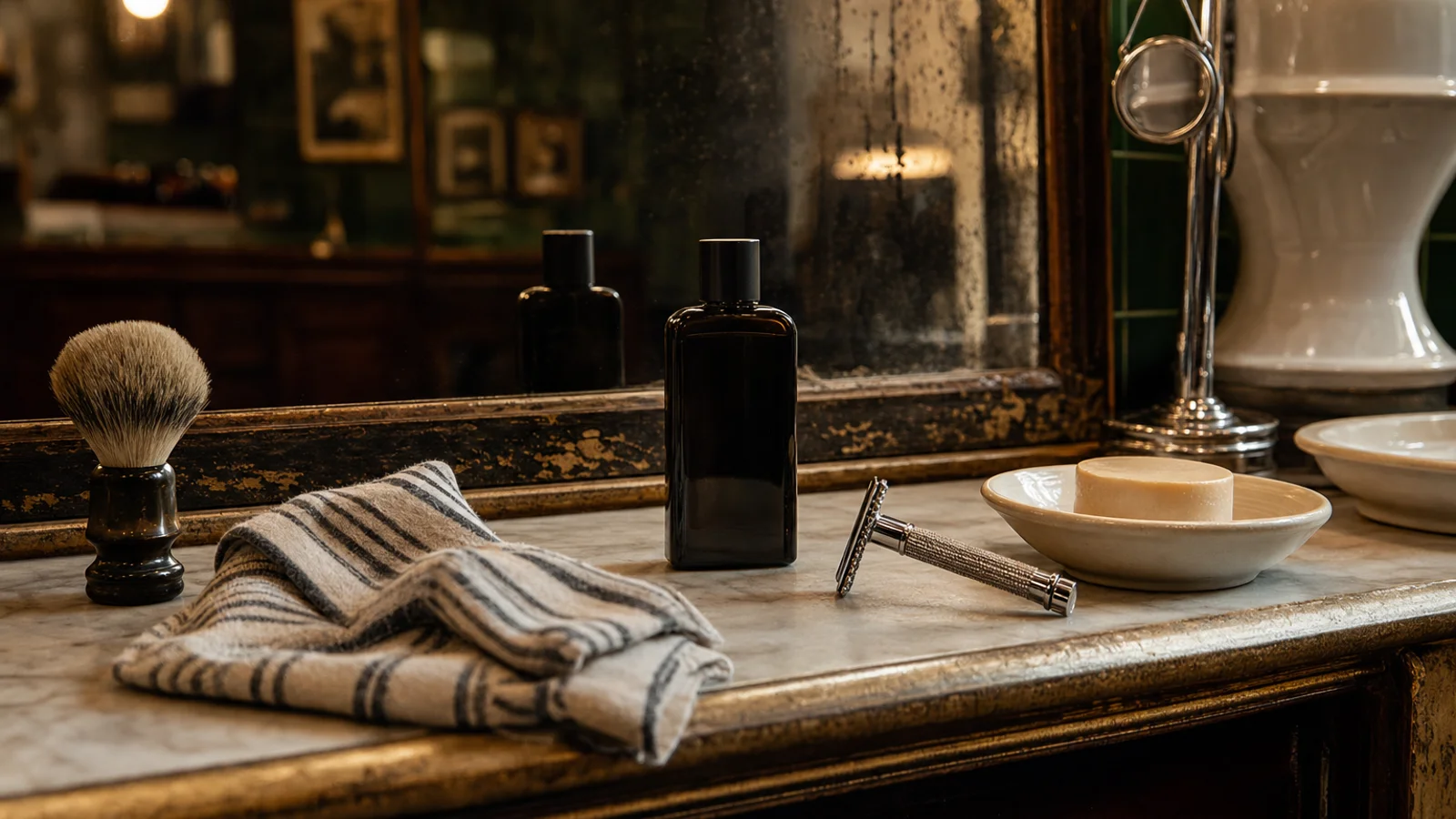
A "masculine fragrance" is a marketing category, not a chemical one. No molecule is inherently male. What the industry calls masculine is a set of note families - fougere, woody, aromatic, leather, tobacco, and amber - that got coded that way through more than a century of advertising, packaging, and barbershop history, starting with a single 1882 launch. That coding still shapes how fragrances are sold today, even though plenty of the best "masculine" scents are now marketed to everyone.
The families that got coded masculine
| Family | Core notes | What it smells like | Example |
|---|---|---|---|
| Fougere | Lavender, oakmoss, coumarin | Fresh, herbaceous, a damp forest floor | Azzaro pour Homme |
| Woody | Sandalwood, vetiver, cedar | Dry, grounded, warm | Santal 33 |
| Aromatic | Clary sage, geranium, lavender | Sharp, herbal, clean | Dior Sauvage |
| Leather | Leather, tobacco, birch | Smoky, worn-in, austere | Bleu de Chanel |
| Amber / oriental | Amber, oud, spices | Warm, dense, resinous | Tobacco Vanille |
That is the full list. Note the gap: nothing here is chemically or biologically gendered. It is a convention, learned the same way everyone learns that pink is for girls and blue is for boys.
Where the convention comes from
The clearest founding moment is 1882, when Houbigant launched Fougere Royale, built around lavender, oakmoss, and coumarin. It was not trying to smell like a fern - "fougere" is French for fern, but the accord is an abstraction, not a botanical copy - it was trying to smell like a gentleman's toilet water. The bottle you can buy today is Houbigant's 2010 reissue, rebuilt by Rodrigo Flores-Roux under modern IFRA limits rather than the original 1882 formula. That formula became the template for fougere as a category, and for most of the 20th century, "fougere" and "men's fragrance" were close to interchangeable. You can still smell the lineage directly: Azzaro pour Homme, launched in 1978 and built by perfumer Gerard Anthony, is a barbershop fougere in the same tradition, and it still divides opinion today the way an old-school formula does.
Barbershops did a lot of the coding work. Shaving soap, aftershave, and hair tonic were fougere-and-aromatic-based for decades, so those families became associated with grooming, and grooming became associated with men. Leather followed a similar path through military and equestrian goods. Tobacco rode in on cigar culture and gentlemen's clubs. None of it was inevitable; all of it stuck.
The 1990s aquatic wave changed the palette
The next big shift in "what counts as masculine" came almost a century later, in the late 1980s and 1990s, when marine and aquatic accords arrived. Davidoff Cool Water, launched in 1988, is the clearest example still on shelves: mint, lavender, and a synthetic "sea water" note built for sport and daily wear rather than a barbershop chair. It sold enormously well and dragged an entire generation of "masculine" fragrance away from mossy and herbal territory and towards clean and fresh. By the mid-1990s, aquatic had become as coded masculine as fougere ever was, purely because enough big brands launched enough aquatic scents at men in a short space of time.
That is the pattern worth remembering: the masculine code is not fixed. It gets rewritten by whichever launches sell well enough in a given decade.
The line has moved again, and it is worth being honest about it
The current shift is towards no line at all. Le Labo Santal 33, built on creamy sandalwood, is one of the most influential fragrances of the last fifteen years and is marketed unisex from the outset, not retrofitted into it. Tom Ford Tobacco Vanille sits in the same amber-and-tobacco territory as plenty of "masculine" fragrances yet ships under Tom Ford's unisex Private Blend line, and community discussion treats it as unisex in practice as well as on the box. Community discussion on r/fragrance returns to this point often: whether "masculine" and "feminine" describe the fragrance at all, or just describe who a marketing department pictured spraying it.
Being honest about this matters because gendered marketing has a real cost: it talks people out of fragrances they would like. A woman who assumes she cannot wear a fougere, or a man who assumes a rose-forward scent is off-limits, is working from a convention that a perfume house invented to sell more bottles, not from anything in the liquid itself. If a note list appeals to you, that is the only signal worth trusting. The gender label on the box is packaging, not chemistry.
Where to start
A sensible way into "masculine" fragrance is to pick one family from the table above and try the version that defined it, rather than the newest flanker. Four real starting points across price points, all in our catalogue with full verdicts:
- Budget: Davidoff Cool Water EDT - the aquatic-fresh template, still cheap, still works for daily wear and sport.
- Mid: Guerlain Habit Rouge EDP - a spicier, more old-fashioned fougere-oriental than Azzaro, from a house (Guerlain) that has been making them since the 1960s.
- Premium: Bleu de Chanel EDT - the modern woody-citrus blueprint, built by Jacques Polge, and the fragrance most often cited as the "safe" masculine choice for a reason.
- Luxury: Creed Aventus EDP - smoky birch and pineapple, the fragrance that launched a decade of "boardroom" marketing and a thousand imitators from Creed.
If none of those note profiles appeal, do not force it. Read a handful of note pages - oud, vetiver, iris, patchouli - and follow whichever one you actually like the sound of. Our perfume notes guide and accords guide explain how those individual notes combine into the accords in the table above, and every perfume page carries our own verdict rather than a marketing description.
Common questions
Is there a scientific difference between masculine and feminine fragrances?
No. The oils, aroma chemicals, and extraction methods are identical regardless of who the marketing targets. The difference is which note families a house chooses to lean on and how it packages and advertises the result.
What notes are considered most masculine?
Fougere (lavender, oakmoss, coumarin), woody (sandalwood, vetiver), leather, tobacco, and amber/oriental spice are the families the industry has coded masculine since the 20th century, largely through barbershop and grooming associations rather than anything inherent to the notes.
Can a woman wear a masculine fragrance, or vice versa?
Yes, without qualification. Fragrance has no biological gender. Plenty of fragrances originally marketed to men, including several linked above, are now sold and worn as unisex.
Why do "masculine" fragrances often smell similar to each other?
Because the industry tends to cluster around whatever is currently selling. The 1990s produced a wave of near-identical aquatics; the 2010s produced a wave of ambroxan-forward "fresh spicy" scents in the wake of Dior Sauvage. Following one hit with a similar-smelling one is a lower-risk launch than doing something new.
What is the most iconic masculine fragrance of all time?
There is no single answer, but Fougere Royale has the strongest claim as the fragrance that started the category in 1882 (the current Houbigant release is a 2010 reconstruction), with Azzaro pour Homme and Dior Sauvage as the defining fragrances of their respective decades.
A note on sources
This explainer is drawn from the documented history of fougere and aquatic perfumery, cross-checked against the accord and note data we hold in our own catalogue, and informed by community discussion on where the masculine/feminine line actually falls in wearer practice. Every perfume named above carries its own page with our verdict, notes, and accords rather than a marketing summary. For how we arrive at those verdicts, see our methodology page.