Old Books
Note Profile
About
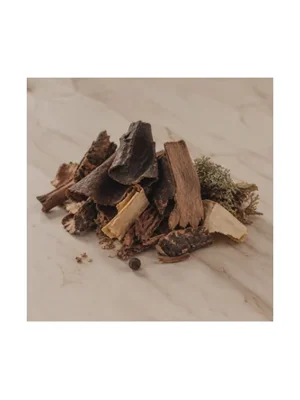
Old Books is the smell of ageing paper. One primary source puts it in a sentence: grassy notes, a tang of acids, a hint of vanilla, over an underlying mustiness. All four come from paper breaking down, not from anything added. The vanilla is vanillin released as lignin in wood-pulp paper degrades, which is why cheap twentieth-century paper smells sweeter than rag paper.
Scent Profile
Grassy green comes first, the descriptor the source puts at the front of its sentence. Musty earth sits underneath and holds the whole thing up. A dry woody character reads as pulped and pressed wood, which is what the paper is. A sour acid tang cuts across it, from the acetic and formic acids that degrading paper releases. Sweet vanillic warmth follows from lignin-derived vanillin, present but never leading. Dry powdery dust fills the gaps. A mineral coolness, a faint almond nuttiness from benzaldehyde, a low mossy shade and a trace floral lift complete it.
ScentWheel
Read off the wheel, not a label applied to the note.
Origin
Not a material and not an extract. It is the headspace of degrading paper, measured by Strlic and colleagues in 2009 by GC-MS on historic book samples. They identified several hundred volatile and semi-volatile compounds off-gassing from the paper and the object as a whole. Named contributors include benzaldehyde for almond, vanillin for vanilla, ethylbenzene and toluene for a general sweetness, and 2-ethylhexanol for a slight floral lift. Perfumery rebuilds it as a composed accord.
Usage in Perfumery
A niche and candle accord, used to give a fragrance a setting rather than a smell: a library, an archive, a study. It is usually built with paper, dust and dry wood materials, then sweetened with a small vanillic dose so it does not read as pure mould. It works under leather and tobacco in a study accord, and it needs a dry base or the mustiness turns sour.
Similar Notes
Perfumes featuring Old Books
A selection of reviewed perfumes where Old Books appears prominently.
No perfumes featuring this note have been reviewed yet. Check back soon.