Onycha
Note Profile
About
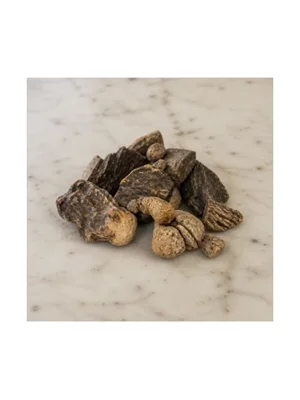
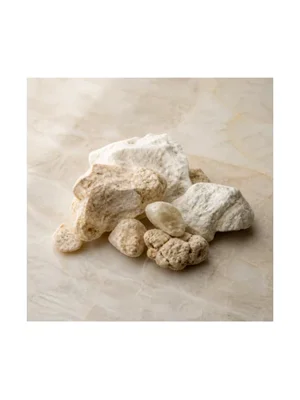
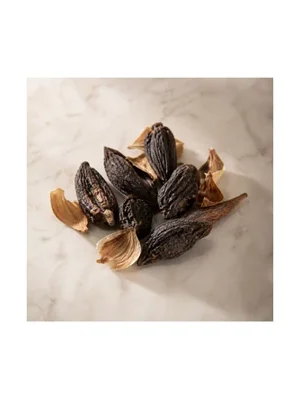
Onycha is the operculum of a marine sea snail, the horny plate the animal uses to close its shell. Muricidae species, mainly Chicoreus ramosus, supply the trade. It is burned as incense and used as a fixative. The smell is animalic and leathery with a salty, mineral, marine edge, and several sources say plainly that it is not pleasant on its own.
Scent Profile
Animalic leads. The peer-reviewed source says burning the operculum gives an odour "described as being similar to that of castoreum", and Fragrantica's own note text opens with "leathery and animalic". Mineral is the other half of the material and comes from the raw state: an incense maker who handles it in bulk says it "imparts a salty, sea, mineral like note in the original state", and Fragrantica independently reaches for "salty, briny, and mineral-like". Leather is named directly by both of those sources. Aquatic_ozonic carries the marine side of that same salty read, the smell of the shore rather than of clean sea air - a perfume using it is described as smelling of "the animal rancidness of seashore mud". Smoky is the burning, which is how the material has been used for three thousand years; it is scored well below choya nakh's 0.85 because onycha is the shell itself rather than a smoke condensate. Sulphurous is the failure mode the same incense maker warns about: scrub the shells hard and you get "that scary old half fermenting seafood scent". Under those, dry_woody and amber_resinous carry Fragrantica's "woody, incense-like", powdery is the touch the trade blog says it adds to an incense stick, and earthy and sour are the shore mud and the rancidity. TWO STATES, ONE VECTOR. Raw operculum reads mineral and marine; burned or properly processed operculum reads animalic and leathery. Every source treats these as one material at two stages, not two materials, so both are in the vector and animalic and mineral are co-dominant.
ScentWheel
Read off the wheel, not a label applied to the note.
Origin
Animal. The opercula are collected from marine gastropods, chiefly Muricidae, and are still exported from India to Europe for perfume, cosmetics and medicine. A peer-reviewed study in Scientific Reports calls the operculum possibly "the most ancient animal derived aromatic to have an extensive global use". Arabic sources call it azfar al-tibb, sweet hoof, and Latin ones unguis odoratus. The Babylonian Talmud records the preparation: the shells were rubbed with an alkali made from bitter vetch to remove impurities, then soaked in fermented caper-berry juice or strong white wine to improve the smell. The plate is chitin and chitosan, both odourless. What smells is the marine protein trapped with them and its breakdown after harvest. THE REFERENT IS DISPUTED. A live minority reading holds that the onycha of Exodus 30:34 was labdanum, not a mollusc product, argued on kosher law and etymology rather than on smell. This note is scored on the operculum reading, because that is what every trade and incense source describing onycha today is describing.
Usage in Perfumery
Mostly incense rather than alcoholic perfume. Ground opercula go into North African and Middle Eastern bakhoor and into East Asian incense, where they bind the blend, hold scent molecules down and add depth and a powdery touch. Two independent sources call it a fixative in the same breath as musk and ambergris, which is the honest description of its job: it is used for what it does to a blend, not because it smells good alone. Attested 4 times on Fragrantica and 4 on Parfumo across 4 brands, counting Onycha and Onycha absolute together. Dry distillation of the same shells gives a different product entirely, choya nakh.
Similar Notes
Perfumes featuring Onycha
A selection of reviewed perfumes where Onycha appears prominently.
No perfumes featuring this note have been reviewed yet. Check back soon.