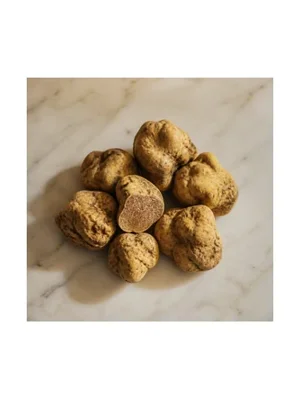
White Alba Truffle
Note Profile
About
Damp earth with garlic through it, then honey and hazelnut. Tuber magnatum, the white truffle of Alba. Both trade sources put the same two things first in the same order, and a chemistry paper names the compound behind the second: bis(methylsulfanyl)methane, present at 237 to 4360 micrograms per kilogram and undetectable in the lookalike species Tuber borchii.
Scent Profile
Earthy leads because all three sources put it first and two of them say 'damp earth' in those words. It sits just under the published truffle at 0.85 because the sulphur takes a real share of the note here. Sulphurous is the facet that earns this note its own row. Both trade sources name garlic without prompting, and the chemistry paper grounds it: bis(methylsulfanyl)methane is the marker compound for this species and is absent in the species it gets substituted with. Animalic carries Casa di Langa's 'musky notes' and its 'aged cheese', and it is held under truffle's 0.52 because only one of the three sources says musky. Honeyed is named independently by both trade sources. Nutty is hazelnut, named twice by Tartuflanghe. Tobacco_hay takes 'undergrowth' and 'hay' together, which read closer to dry hay than to fresh green. Below the reported band: warm_spice for 'spices', named twice and never specified; green for artichoke, named once; dry_woody and fruity, unstated here but carried by the parent truffle note and kept small rather than zeroed; mossy_chypre for the forest-floor side of undergrowth; and sour for the cheese.
ScentWheel
Read off the wheel, not a label applied to the note.
Origin
The fresh fruiting body of Tuber magnatum, dug in Piedmont in autumn and sold whole. It is not extracted for perfumery, so the note in a bottle is a reconstruction. Casa di Langa describes a fresh specimen as giving 'an intense, complex, and well-balanced scent, with earthy, garlicky, and honeyed notes that should be detectable at close range'. Tartuflanghe lists the same profile from the producer side: 'notes of garlic, artichoke, honey, hazelnut, damp earth, and spices'. The peer-reviewed work is chemotaxonomic rather than sensory, written to catch food fraud, and it reports T. magnatum as 'valued for its stronger and richer aroma compared to other Tuber species'.
Usage in Perfumery
A base note for gourmand, earthy and deliberately savoury compositions. Attested on 4 Parfumo placements across 4 brands and on no Fragrantica note listing, which fits a term niche houses name openly. Use it where the published truffle note is too generic: the garlic-sulphur is the whole reason to reach for this one rather than that one, and it is what makes a composition read as this species and not as fungus in general.
Similar Notes
Perfumes featuring White Alba Truffle
A selection of reviewed perfumes where White Alba Truffle appears prominently.
No perfumes featuring this note have been reviewed yet. Check back soon.