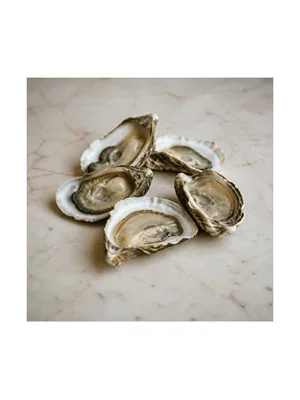
Oysters
Note Profile
About
Oysters is a marine note built on brine and wet mineral. The perfumery trade reads it clean: marine, mineralic, salty, with a metallic tang. Food science measures something more vegetal than that, with grass, cucumber and melon over a sulphurous canned-corn note from the oyster's own dimethyl sulfide. Both readings are in this vector, which is why sulphurous and green are here and the spreads are wide.
Scent Profile
Aquatic_ozonic is the dominant facet and both source families agree. Nottier: 'a marine and mineralic essence, reminiscent of the sea'. Happy Oyster: 'smells mildly of seawater and the seaside', with 'marine' and 'fresh' in the researcher list. Mineral is nearly as strong and is the facet that makes this an oyster rather than open water. Nottier gives 'a briny, slightly salty aroma, sometimes with a subtle metallic tang'. Popular Science gives the bromophenol chemistry behind the brine and its iodine character at high concentration. The researcher list has 'metallic-like' independently. Sulphurous is the facet that separates this note from Sea Water, Salt and Sea Shells, and it has the most specific evidence in the whole dossier: dimethyl sulfide, named as the compound, with canned corn as the described smell. Green covers 'grass, green, plant-like' and 'cucumber-like' from the same researcher list. Below the reporting line: fruity is 'melon-like'; animalic is low because no descriptive source calls it animalic and the only thing pointing that way is Fragrantica's grouping; floral is the single 'flowery (lilac)' mention; clean_musk is a small allowance for the sea-air character that Sea Water and Salt both carry.
ScentWheel
Read off the wheel, not a label applied to the note.
Origin
The referent is the live or freshly shucked oyster, not a processed material. Happy Oyster Company, citing food-science work, reports that 'a raw, fresh Eastern Oyster (C. virginica) smells mildly of seawater and the seaside', and that researchers describe its aroma compounds as 'canned corn, grass, green, plant-like, metallic-like, melon-like, cucumber-like, as well as marine, fresh, and flowery (lilac)'. The savoury element is dimethyl sulfide, which the oyster makes from algae it feeds on, and which is the compound scientists liken to canned corn. Popular Science traces the brininess of oysters and other shellfish to bromophenols, which read sealike and crablike at low concentration and 'a harsh chemical smell, similar to iodine' at high concentration.
Usage in Perfumery
Attested in 12 Fragrantica perfumes and none on Parfumo. Fragrantica files it under musk, amber and animalic smells rather than with the aquatics, which is worth knowing before using it as a clean marine. No supplier names a material as the Oysters note. Calone is the marine synthetic perfumers reach for generally, but no source found links it to oyster odour. It reads sea-breeze because its structure resembles a brown-algae pheromone, so treating Calone as the material behind this note would be a guess and is not scored as one.
Similar Notes
Perfumes featuring Oysters
A selection of reviewed perfumes where Oysters appears prominently.
No perfumes featuring this note have been reviewed yet. Check back soon.