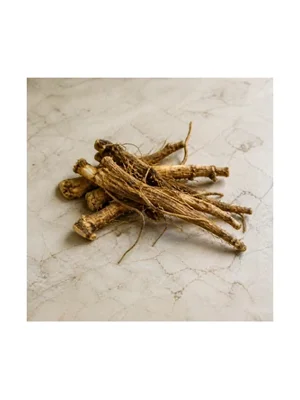
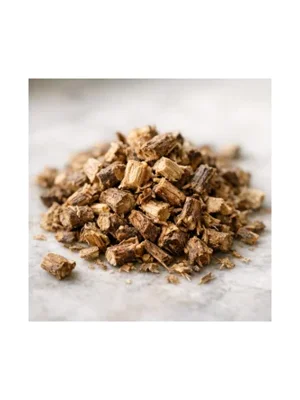
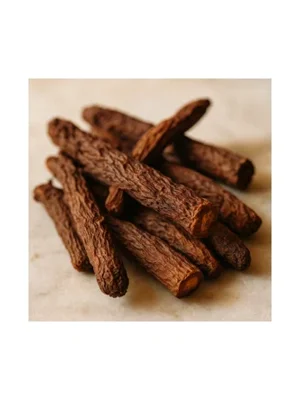
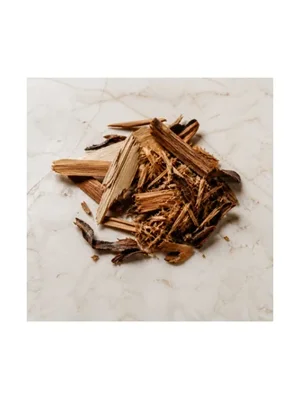
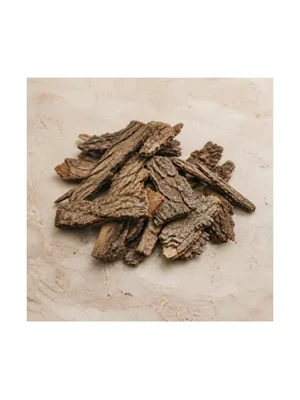
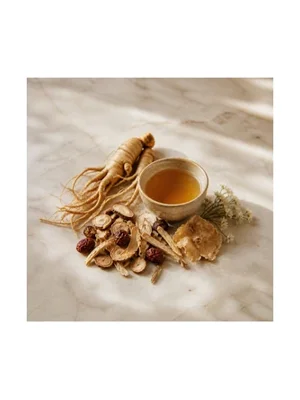
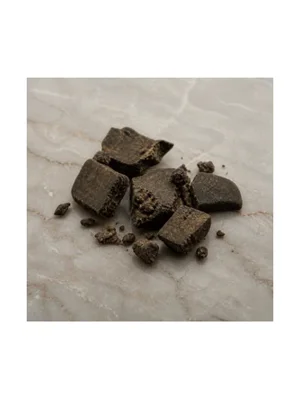
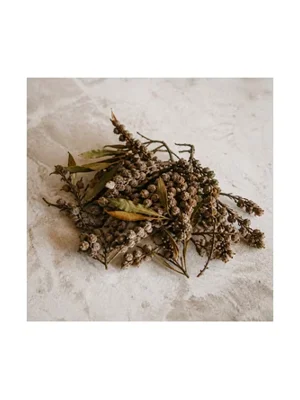
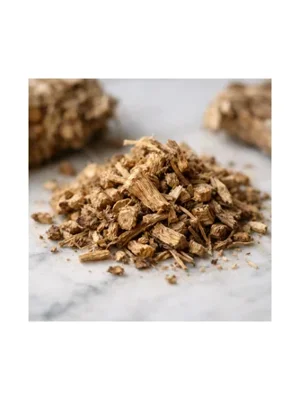
Angelica root is the plant material that behaves like an animal product. Steam distilled from dried Angelica archangelica root, it smells earthy and musky, with a gentle skin-like animalic warmth that no other herb has. The musk is real chemistry, not metaphor: the oil contains pentadecanolide, a macrocyclic musk lactone sold on its own as a synthetic musk.
Scent Profile
Earthy first and hardest - damp forest floor, root cellar, celery-earth. A clean macrocyclic musk sits right beside it and is described perceptually as warm and skin-like, so an animalic reading runs through the whole material. Warm herbaceous depth, a peppery-green opening from phellandrene and a soft fresh-spice bite complete the top. An amber-like sweetness reminiscent of ambrette seed, a little dry wood, a sweet-herbal coumarin trace and the faint warmth of a worn leather glove close it.
Read off the wheel, not a label applied to the note.
What this is made of
Angelica root oil
A natural extract
CAS 8015-64-3
Angelica archangelica root oil (IFRA NCS A2.12, root). The note's own origin says steam distilled from the root, which is the oil rather than the absolute.
Restricted
An IFRA Standard limits how much of this a perfumer can usethe limit applies to the perfumer, not the wearer
These are facts about the substance, not about any perfume with this note.
Why that matters
A perfume that names Angelica Root can use a different extract, a
reformulated version, or a synthetic reconstruction. It can also hold less
than the amount that requires a declaration. We cannot tell which applies.
These rows cover only the substances we hold a link for.
The dried roots of Angelica archangelica, two to three years old at harvest, steam distilled at a yield of 0.3 to 1 per cent. The roots must be dried first; fresh root gives a different and less useful oil. Grown mainly around Niort in France, and in Germany and Hungary. Alpha-phellandrene carries the peppery-green top, phthalides the celery-earth quality, and pentadecanolide the musk.
Usage in Perfumery
One of perfumery's great natural fixatives, used at 0.5 to 2 per cent. It anchors chypres beside oakmoss and patchouli, adds herbal-amber complexity to fougeres, and gives oriental bases a warm, almost animalic floor. A trace in a citrus cologne adds depth and lasting power without announcing itself. It substitutes for costus, and it overwhelms a blend above 3 to 4 per cent.
A selection of reviewed perfumes where Angelica Root appears prominently.
No perfumes featuring this note have been reviewed yet. Check back soon.
We use cookies to improve your experience and understand how you use our site.
Read our cookie policy
Cookie Preferences
Choose which cookies you'd like to accept. Essential cookies cannot be disabled
as they're required for the website to function.
Always On
Required for the website to function. Includes session management and security tokens.
Help us understand how visitors use the site. We use Umami (privacy-focused,
cookieless) and Google Analytics to measure usage without tracking you across websites.