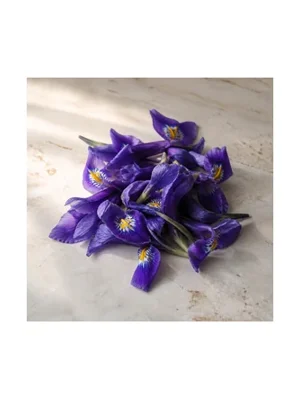
Blue Lilies
Note Profile
About
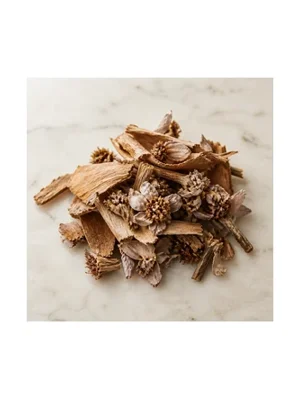
Blue lilies is Nymphaea caerulea, the Egyptian blue water lily, sold in the trade as blue lotus absolute. It is not a true lily and it is not the sacred lotus behind the published lotus and pink-lotus notes. Both sources fetched describe the same material: a waxy, honeyed, narcotic floral with a Crayola-crayon backbone, a faint anise-and-hay undercurrent and a warm pond-water stillness that neither source calls marine. Premiere Peau puts it closer to ylang in weight than to any fresh aquatic floral.
Scent Profile
Honeyed leads because both sources open with it: 'waxy, honeyed floral' and 'lots of sweet heady floral'. Floral sits just under it and is narcotic rather than fresh, the weight Premiere Peau compares to ylang. Powdery carries the crayon: Hermitage reads it as 'borderline parma violet territory' and 'something lilac powdery-esque', and Premiere Peau's 'part crayon' is the same observation from the other side. Fruity is Hermitage's 'mouth-watering cherries' and 'a little lychee orientated', named by one source only, which is why it stays third rank. Lactonic is the waxy, fatty body rather than milk, and the GC-MS supports it, with tetradecanol and a long-chain diene among the dominant constituents. Green is the pond and not the leaf: Premiere Peau is explicit that the aquatic dimension is 'the warm, vegetal stillness of pond water in sun', and Hermitage finds 'aquatic green pond nuances' only deep in the drydown. Tobacco_hay is the anise-sweet undercurrent Premiere Peau places 'somewhere between estragole and dried hay', plus the warm-tea quality it attributes to trans-alpha-bergamotene. Aromatic_herbal is the anise half of that same phrase. Aquatic_ozonic is deliberately held, because Premiere Peau states the aquatic dimension 'is not marine or ozonic'. That is the facet this row must not inherit from the published lotus and water-lily notes. Mineral is Hermitage's 'dry chalk like trait'.
ScentWheel
Read off the wheel, not a label applied to the note.
Origin
Nymphaea caerulea (Nymphaeaceae) is a water lily, extracted as an absolute from the flowers. The trade name 'blue lotus' is a misnomer that both sources correct in their own copy, since true lotus is Nelumbo. Premiere Peau cites GC-MS of authentic absolute giving 6,9-heptadecadiene at 11%, benzyl alcohol at 10.5% and tetradecanol at 5.3%, with beta-ionone and trans-alpha-bergamotene carrying most of the perceived odour. The retail note taxonomy this row came from bundles six plants under 'blue lilies': Agapanthus praecox, Nymphaea caerulea, Nymphaea violacea, Stypandra glauca, Thelionema caespitosum and Triteleia grandiflora. Only Nymphaea caerulea has documented perfumery use and a published odour description, and Agapanthus is reported elsewhere as largely unscented. This vector is scoped to N. caerulea, and by trade convention to its sister species N. violacea, which no source fetched described on its own.
Usage in Perfumery
A heavy floral used in the heart and base, where a composition wants narcotic sweetness without the banana-custard of ylang or the indole of jasmine. Attested on 7 Fragrantica entries under Flowers and none on Parfumo. Both suppliers sell the absolute as a rarity and price it accordingly. One thing a reviewer must act on: the aliases 'Blue Lotus' and 'Blue Lotus Absolute' currently resolve to the published lotus note, which is scored aquatic_ozonic. Both sources here state that this plant is not Nelumbo and that its aquatic quality is not ozonic. Those aliases point at the wrong row and belong here.
Similar Notes
Perfumes featuring Blue Lilies
A selection of reviewed perfumes where Blue Lilies appears prominently.
No perfumes featuring this note have been reviewed yet. Check back soon.