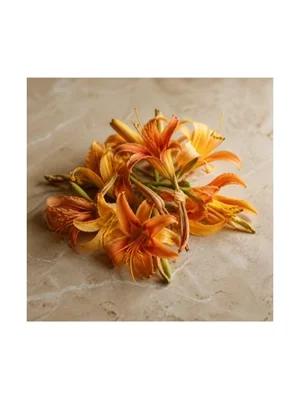
Daylily
Note Profile
About
Daylily is a light fruity-rosy floral with a lemon edge and a grassy lift. Most daylilies grown today have almost no smell. The note describes the minority of cultivars that do.
Scent Profile
Floral leads because 2-phenylethanol, which the compound study describes as having 'a rose flavor', was 'detected in high concentrations in most varieties', and the NYBG guide calls the best cultivar's scent 'truly floral'. That is a rosy floral, not a white one. Fruity is the terpenoid group the same study names three times over: nerolidol 'has a sweet fruity flavor with a tinge of woody flavor', geraniol 'has a fruity fragrance', linalool likewise, and nonanal and decanal add 'fruity and floral flavors'. Green is (E)-beta-ocimene, which 'has a grassy taste and floral aroma'. Citrus is the lemony type, carried by Hemerocallis citrina and its hybrids. NYBG describes one cultivar as 'a bit more lemony' and another simply as a 'lemony floral fragrance'. It is a whole-genus average of two different cultivar characters, which is why its spread is the widest here. Sweet_vanillic is the plain 'sweetly scented' of the trade listings, held at the bottom of the naming range because no source gives it more character than that. Below: honeyed and dry_woody are the 'tinge of woody' on nerolidol and the claim that 'benzaldehyde contributes a woody flavor'. White_floral is indole, which the study reports only as 'floral' and never as animalic. Aldehydic is inferred from nonanal and decanal being C9 and C10 aldehydes rather than from any descriptor, so it is deliberately kept at trace.
ScentWheel
Origin
Daylily is Hemerocallis, a genus with no relation to true lilies (Lilium) beyond the shared common name. No absolute, oil or headspace product is sold for it, so any daylily note is a reconstruction. The vector rests on an aroma-compound study of the genus, which finds the scent built mainly from terpenoids: nerolidol reading sweet-fruity with a woody tinge, geraniol and linalool fruity, (E)-beta-ocimene grassy and floral, plus rose-scented 2-phenylethanol at high concentration in most varieties tested. Garden sources supply the rest. The New York Botanical Garden states that daylilies 'as a whole are not a particularly fragrant perennial'.
Usage in Perfumery
A soft heart floral for spring-garden and fruity-floral accords. It is not a substitute for lily. The genus is benzenoid-poor and lacks the methyl-benzoate weight that carries a true lily reconstruction, so daylily sits closer to rose-and-fruit than to white floral.
Similar Notes
Perfumes featuring Daylily
A selection of reviewed perfumes where Daylily appears prominently.
No perfumes featuring this note have been reviewed yet. Check back soon.