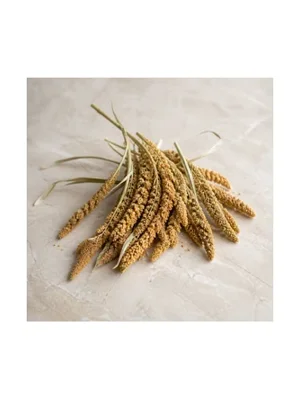
Millet
Note Profile
About
Millet is the small cereal grain. Two GC-MS studies agree on what drives its smell: aldehydes, and mostly the straight-chain ones from hexanal to decanal. Those read grassy, green and fatty, with citrus edges on the longer chains. Over that sits what both papers simply call cereal aroma, plus a nutty and malty side. So the vector leads green and aldehydic, not sweet and toasted. That separates it from the published cereals, wheat, barley and oat notes, which are all built on nutty and tobacco_hay with sugar behind them.
Scent Profile
Green leads because both papers put it there independently. The porridge study names 'green, fruity, and malty aromas' for the aldehyde class, and the GC-MS study spells out the grassy and green descriptors compound by compound: hexanal grassy and green, octanal green, nonanal green, decanal grass. Aldehydic is directly stated rather than inferred. Both papers say aldehydes are the most abundant class and the one that matters most for odour, and the fatty, waxy, soapy character they describe is what this facet is for. Nutty carries 'oil, fat, fruity, and nutty flavors' and is the closest available fit to the cereal character both papers name. Tobacco_hay carries the rest of that cereal reading, the dry grain and straw side, and it is set well below the published cereals note because millet is not toasted. Lactonic is the 'creamy, fatty' half of the same sentence about aldehydes. Fruity is stated twice, once as fruity aroma and once as fruity flavour. Below the naming bar, sweet_vanillic holds malty, aromatic_herbal holds herbaceous, citrus holds the heptanal and nonanal citrus edge, and earthy is the raw grain itself. There is a real vocabulary gap behind these numbers. Neither green nor nutty is cereal, and both papers use that word as though it were a primary descriptor.
ScentWheel
Read off the wheel, not a label applied to the note.
Origin
The seed of small-grained cereal grasses grown across Asia and Africa, chiefly Panicum miliaceum and Setaria italica. The odour evidence here is from food science on the grain itself: a GC-MS study of brown millet, milled millet and millet bran, and a study of volatiles in cooked millet porridge. Neither is about a perfumery material, because no perfumery material exists. No supplier sells a millet oil or absolute.
Usage in Perfumery
One attestation in the Fragrantica note vocabulary, which calls it a fantasy note of cereal, and none in Parfumo. It is a reconstruction. Use it where a grain note needs to stay raw and green rather than baked. Millet is the uncooked-grain end of the cereal family, against malt and cereals at the toasted end.
Similar Notes
Perfumes featuring Millet
A selection of reviewed perfumes where Millet appears prominently.
No perfumes featuring this note have been reviewed yet. Check back soon.