Sake
Note Profile
About
Sake is scored here as the smell of the finished drink, because that is what the three sake-trade sources describe. Two esters carry it. Isoamyl acetate gives banana and honeydew melon. Ethyl caproate gives ripe red apple, pear and pineapple. Together they are what the trade calls ginjo-ka, and all three sources name them. Under the fruit sits a real rose-floral layer from phenethyl alcohol, which BrewSake calls the base incense of sake. The alcohol itself reads sharp rather than warm. The vector is fruit first, then drink, then flower.
Scent Profile
Fruity leads and is the reason the note exists: banana and honeydew from isoamyl acetate, red apple and pear from ethyl caproate, named the same way by three separate sake publications. Boozy is next, and it is the sharp solvent lift of isoamyl alcohol that SAKE Street likens to a permanent marker, not the warmth of a spirit. Floral is a rose from phenethyl alcohol, called the base incense of sake by BrewSake and corroborated as rose-like by SAKE Street. Tropical is the pineapple and lychee edge of the same two esters plus 4MMP. Earthy is the koji stage, which is chemically mushroom rather than grain. Sweet_vanillic is the caramel and maple-syrup end of sotolon, which belongs to aged sake and not to a fresh bottle. Below these, nutty and green sit small, and the documented faults of sake are held at trace: cheesy diacetyl, clove-like 4VG, burnt-brownie isovaleraldehyde and goat-cheese excess ethyl caproate.
ScentWheel
Read off the wheel, not a label applied to the note.
Origin
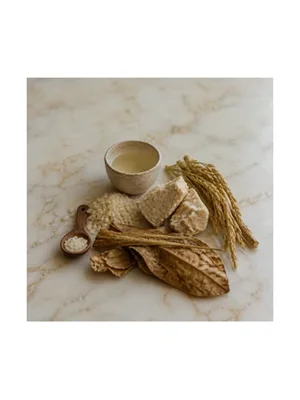
Sake is brewed from polished rice, water, koji mould and yeast. It is not distilled, and it is about 15 to 16 percent alcohol. The aroma is made in fermentation, not by the rice. The compound most directly tied to the rice-and-koji stage is 1-octen-3-ol, which SAKETIMES and BrewSake both describe as mushroom-like, so the note is not a cereal smell. Aged sake, koshu, develops sotolon and turns towards maple syrup, caramel and burnt sugar.
Usage in Perfumery
19 Fragrantica placements and 9 Parfumo placements across 5 brands. Fragrantica files it under Beverages. Perfumery uses it as a top-note conceit in Japan-referencing compositions, usually paired with rice, cherry blossom or yuzu. No fragrance house publishes how it builds a sake accord, so the usage claim here is from placement counts and category, not from a formula.
Similar Notes
Perfumes featuring Sake
A selection of reviewed perfumes where Sake appears prominently.
No perfumes featuring this note have been reviewed yet. Check back soon.